

August 18, 20269 min read
Team Assist: After the handoff, AI has a different job
Customer-facing AI is built to resolve. Once a person takes over, the better use of AI is to compress context, frame the decision, and help them act.

Authors: Steve West and Matt Baker
Team Assist, announced at Gladly Connect Live 2026, is now available to all Gladly Team customers.
Most customer-facing AI is measured by what it can finish on its own. Did it answer the question, complete the task, or route the customer to the right place? Those are sensible measures for an AI agent whose job is resolution.
But the moment the AI hands a conversation over to a person, the nature of the work changes.
The straightforward cases have often already been resolved. What remains is more likely to involve ambiguity, incomplete information, a policy exception, or a customer relationship that could turn on the next response. A person now has to weigh the facts, understand the history, interpret the policy, and make a judgment call while the customer waits.
At that point, the AI should not keep acting like an autonomous agent that failed to finish. It should take on a different job.
It should help the person understand the situation and decide what to do next.
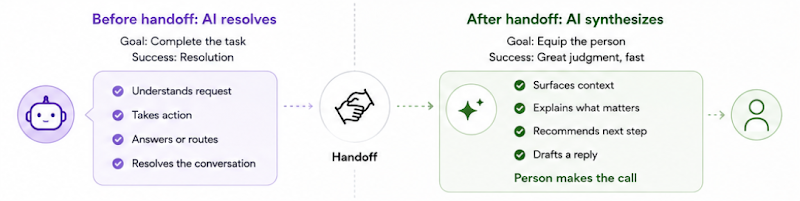
That distinction is the idea behind Team Assist. Before the handoff, Gladly AI works toward resolution. After the handoff, Team Assist works toward synthesis: gathering the relevant context, explaining what matters, answering questions, recommending a next step, and drafting a response for a person to review.
One resolves. The other equips.
A handoff changes the problem
Most software treats a handoff as a routing event. A conversation moves from an AI agent to a queue, and then from the queue to a member of the team.
For the person receiving it, however, the handoff often arrives as a research assignment.
They have to read the conversation, work out what the customer is asking for, understand what the AI already attempted, search through previous interactions, check the applicable policy, and decide how to respond. That can take eight to ten minutes before they write a useful word to the customer.
A transcript is not enough. It tells the person what was said, but not necessarily what matters.
This is especially true because conversations handed to people are not a random sample of customer service work. They are the cases the AI could not or should not complete on its own. They may involve conflicting facts, unclear intent, an exception to the normal process, or a decision with consequences beyond the immediate transaction.
The person needs more than a second answer engine. They need the situation framed for judgment.
That means the useful output after a handoff looks different. The AI should identify the reason for the escalation, surface the relevant parts of the customer’s history, connect those facts to the company’s policies, call out uncertainty, propose a next step, and help the team member communicate it clearly.
The goal is not to replace the judgment, but rather to remove the work required to get ready to make it.
Synthesis is more than summarization
It is tempting to describe this as summarizing a conversation, but a summary only compresses what happened. Synthesis explains what is important now.
Suppose a customer is asking for a refund outside the normal return window. A summary might say that the customer bought an item 45 days ago, contacted support twice, and is now requesting a refund.
A useful synthesis goes further. It might surface that the first shipment arrived damaged, that a replacement was delayed, that the customer has placed twelve orders without a previous return, and that the company’s policy allows an exception when fulfillment problems caused the delay. Those are the types of details that change the decision.
Team Assist works inside the Gladly Team workspace for the duration of the conversation. It can draw from the customer’s relationship with the brand, including prior conversations across channels, order information available to Gladly, and the same company knowledge that powers your Gladly AI agent.
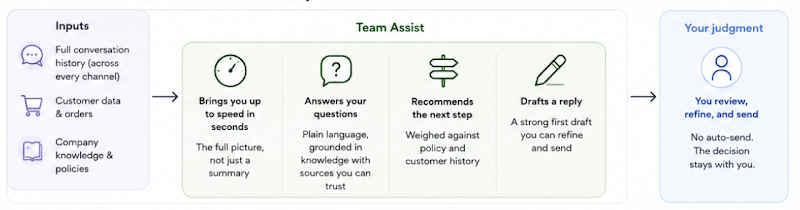
It uses that context to bring the team member up to speed, answer questions in plain language, and show the sources behind its answers. It can recommend a next step based on the customer’s history and the relevant policy, then draft a response the team member can refine and send.
The difference is important. Team Assist is not merely recalling information. It is organizing that information around the decision in front of the person.
The person still makes the call
Team Assist does not automatically send its drafts. This is something we developed into a deliberate product boundary.
The conversations that reach a person often require discretion. There may be several reasonable responses, each with different implications for cost, policy, and the customer relationship. The relevant facts can be assembled by a machine, and a recommended response can be generated by one, but accountability for the decision should remain with the person handling the conversation.
Team Assist frames the situation and proposes a move. The team member reviews the evidence, applies their judgment, and decides what the customer will receive.
This is a different model from putting a generic writing assistant beside the reply box. The objective is not simply to produce polished language faster. A polished answer based on the wrong facts is still the wrong answer.
The system has to help with the reasoning before it helps with the writing.
The context should not reset at handoff
One of the strangest patterns in customer service software is that an AI can spend several minutes gathering information, only for most of that context to disappear when a person takes over.
The customer then has to repeat themselves, or the team member has to reconstruct the situation from a transcript. Ownership changes, and the system behaves as though the conversation has started again.
We think the handoff should preserve the intelligence already gathered.
Team Assist and Gladly AI agents run on the same underlying foundation. They use the same knowledge sources and the same context graph, which connects information across conversations, channels, and orders. That foundation reflects more than a decade of retail experience and 450 million customer conversations.
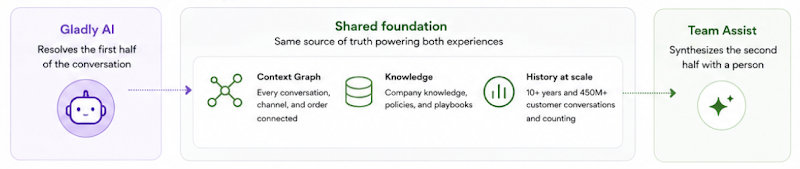
The shared foundation matters more than whether the two experiences look identical. Gladly AI agents and Team Assist have different jobs, so they should produce different outputs. But they should not operate from different versions of the customer.
Before the handoff, that context helps the AI determine whether it can resolve the request. After the handoff, the same context helps a person understand why it could not, what has already happened, and which decision now needs to be made.
The source of truth stays the same. What changes is how it is used.
Compress context, not judgment
Efficiency is easy to misunderstand in high-stakes customer conversations.
The objective is not to make every conversation as short as possible. Some conversations deserve more time. A disputed charge, a damaged order before an important event, or an exception for a long-time customer may require care that cannot be reduced to a standard workflow.
What should be reduced is the time spent searching, rereading, switching between systems, and drafting from a blank page.
Team Assist is designed to make the mechanical parts fast so the person can spend more of their attention on the consequential part. It compresses the work of getting oriented without forcing the decision itself.
That changes how success should be measured.
Before a handoff, useful measures include resolution, task completion, and whether the AI correctly identified when a person was needed. After the handoff, the questions are different: How quickly did the team member understand the situation? Could they find a grounded answer without leaving the conversation? Did they reach a useful response faster? Did the assistance improve consistency without removing discretion?
In one early-access deployment, 64% of team members replied faster after their first session with Team Assist, and 97% of their questions received a meaningful answer. Those are early signals, but they point to the opportunity: the work surrounding a decision can be made much faster without pretending the decision no longer needs a person.
The hardest conversations are often the most valuable
An AI handoff is sometimes treated as a failure to automate. That is the wrong way to think about it. Some conversations should reach a person. The challenge is making sure they reach someone who is ready to help.
The cases that require judgment are often the moments when a customer forms a lasting opinion of the brand. A policy exception can show whether the company understands the purpose behind its own rules. A difficult return can become an exchange. A cancellation request can reveal a problem the company still has a chance to fix.
These conversations can take longer, and that time may be well spent. But it should be spent understanding the customer and choosing the right response, not reconstructing facts the system already knows.
The role of AI is therefore not limited to replacing repetitive work. It can also make human judgment more effective by ensuring that the person begins with the right context.
That is a more demanding use of AI than drafting a reply from the latest message. It requires persistent customer context, grounded company knowledge, visible sources, clear product boundaries, and an experience designed around how people actually make decisions.
It is also where AI can have the greatest effect on the customer relationship.
The handoff should not be where intelligence ends
Customer-facing AI should resolve the requests it can resolve accurately and safely. When it reaches a request that needs a person, it should not disappear and leave behind a transcript.
It should change jobs.
Gladly AI agents work to complete the repeatable parts of customer service. Team Assist helps people handle the ambiguous and consequential parts. Both draw from the same understanding of the customer, but each is designed for a different definition of success.
Resolution closes the work the AI can complete, and synthesis prepares a person for the work only they should decide.
The handoff should not be where intelligence ends. It should be where intelligence changes form.