October 9, 20269 min read
How WeNatal scaled a concierge customer experience without losing the human touch
4 team members handling 1,300 conversations a month — and a 4.9/5 CSAT to show for it.


The challenge
When your customers are trying to start a family, a wrong answer isn't just annoying
Most supplement companies get questions about shipping.
WeNatal gets questions about fertility.
Customers reach out while trying to conceive, during pregnancy, weeks after a new baby arrives. They want to know why a specific ingredient is included at a specific dosage. Whether a formula is safe in the first trimester. Why their shipment is held up and whether it'll arrive in time.
These aren't questions a scripted response can answer well.
For Penny Gibben, Director of Operations and Customer Care, that reality shapes everything about how the team works. WeNatal's products are research-backed and intentionally formulated — every ingredient chosen for a reason, every dosage deliberate. Customers know this, and they ask accordingly.

"They're not like, 'where's my tracking number?' They've got their tracking number. They're like, 'why is it held up in Seattle and I'm in Florida?'"
Penny Gibben
Director of Operations and Customer Care, WeNatal
The team started on Reamaze, then moved to Gorgias. Volume grew. They added team members. Then they tried something that seemed like a reasonable next step: AI responses.
It didn't go the way they hoped.
Gorgias's AI would surface answers that looked similar to past conversations but missed the nuance entirely. A customer asking a specific question about vitamin A — a precise, pointed question — would get a long, generic response that felt evasive. Outdated information came back with full confidence. And when the AI closed a ticket without actually doing anything — telling a customer it would cancel their order, then doing nothing — someone on the team had to track it down and fix it.
On Gorgias, the AI experiment created more work than it solved.

"Every single AI ticket had to be checked by a person. There were mistakes on almost all of them."
Penny Gibben
Director of Operations and Customer Care, WeNatal
The issue wasn't just accuracy. It was fit.
WeNatal's customers aren't asking the same questions other shoppers ask. They're navigating some of the most personal decisions of their lives, and they can tell the difference between a real response and a generated one. Customer feedback reflected the difference — conversations handled by people consistently generated warmer responses than those handled by AI.
The team ultimately decided to take a different approach to AI at WeNatal. Rather than replacing customer conversations, they wanted it to support the people having them.
Why Gladly
One platform. One timeline. A knowledge base that actually works.
Penny had used Gladly at a previous company. When WeNatal started running into the limits of Gorgias, she didn't need to be convinced to look at it again — she needed to see whether the newer version solved what had held her back before.
Two things stood out.
The first was the knowledge base. Before Gladly, answers were scattered across multiple tools and documents. Agents had to leave the conversation just to find what they needed. With Gladly, customer-facing responses, internal guidance, and conversation history all live in one place.
"It kind of slices and dices all that information. Here's the customer-facing response. Here's some additional information for the team member."
Penny Gibben
Director of Operations and Customer Care, WeNatal
The second was conversation history. WeNatal's customers come back month after month, sometimes for years. A customer returning for a second pregnancy is a different conversation than someone who bought once six months ago and is thinking about coming back. In Gorgias, that context lived in separate tickets — each one its own click, its own scroll. In Gladly, it's right there: purchase history, first order date, total spend, every prior interaction in a single timeline.
"It really makes a difference to see if they are coming back for a second pregnancy, or only bought one time six months ago and are looking to come back. It's really nice having that information right there."
Penny Gibben
Director of Operations and Customer Care, WeNatal
That continuity matters especially because WeNatal runs an open queue — no assigned agents, anyone can help any customer at any time. A customer who's reached out multiple times throughout her journey shouldn't have to explain everything again because a different agent picked up the conversation.
With Gladly, she doesn't have to.
What changed
More outreach, less overhead
Since moving to Gladly, the team has handled more volume — not because they automated their way there, but because the workflow got out of the way.
One change Penny points to isn't about speed or capacity. It's about proactive outreach.
"I'll come up with projects like, 'I need to reach out to these 300 people and ask if they want to merge their subscriptions.' They can pull them up through Gladly, send an email, someone else can follow up. It's very easy to do those types of projects."
Penny Gibben
Director of Operations and Customer Care, WeNatal
Before, that kind of outreach required significant coordination overhead. Now it's a workflow the team can run without disrupting day-to-day support.
The same thinking shows up in how the team handles individual customers. A customer reached out recently to pause her subscription — she was moving in the next few months and wasn't sure she'd be at her new address when it resumed. The team created a task inside Gladly to fire just before her subscription was set to un-pause. When it did, any care team member could look back at the timeline, see exactly why the subscription had been paused, and know what to do next. No handoff notes. No hunting through old threads.
The team reached out personally to confirm her address before anything shipped. She hadn't moved yet. They resumed the subscription to her original address, then set follow-up tasks to check back once she was settled.
Customers notice. The response Penny hears most often: "You reached out to me."
AI that works for the team, not instead of it
A deliberate choice — and a competitive advantage
WeNatal is an AI-forward company. The founders have made it a priority — every employee is currently taking a company-wide course with an AI expert, learning how to build tools and workflows that make them more effective across their work.
But in customer conversations, the policy is clear: a person responds.
The distinction Penny draws isn't anti-AI; it's strategic. For a brand where trust is the product, automated responses carry real risk. A wrong answer about a supplement dosage during pregnancy isn't just a bad customer experience. It's a brand problem.
So WeNatal is building toward something specific: AI as a resource for agents, not a replacement for them. A tool that helps team members find answers faster, surface relevant information, and move through complex conversations with confidence — while keeping a person in the loop at every step.
"We take the people we have who are already fantastic and augment what they're doing. That's it."
Penny Gibben
Director of Operations and Customer Care, WeNatal
Penny says Gladly's direction on AI reinforced that decision. "I like that Gladly is on the forefront of working with a lot of these AI sources," she says. As WeNatal builds out its agent-assist vision, having a platform moving in the same direction matters.
Where it goes next
The WeNatal Concierge
The biggest initiative on Penny's roadmap has a name: the WeNatal Concierge.
The idea is simple in concept and ambitious in practice. Every customer — whether they're just starting to research preconception nutrition or two years into a postpartum supplement routine — should feel like someone is available to guide them. Not in a scripted way. In the way a knowledgeable friend would.
That means proactive outreach. Educational resources served at the right moment. Nutrition consultations available to every subscriber. Guides, masterclasses, and recipe books that customers actually use.
WeNatal already knows the connection between education and outcomes. Customers who complete a masterclass take their supplements more consistently. Customers who've done a nutrition consult stay subscribed longer. Customers who download guides show better health behaviors.
"The more educated somebody is about their preconception nutrition, their pregnancy nutrition — the better results they have."
Penny Gibben
Director of Operations and Customer Care, WeNatal
The CX team is also bringing nutritionists directly into the support workflow. Instead of relaying questions through a group email chain and hoping the answer filters back, the plan is to give nutritionists direct access to Gladly — so expert answers come from an expert, in the conversation, without the game of telephone.
The metric WeNatal tracks isn't response time or ticket volume. It's whether customers feel supported, cared for, and genuinely helped.
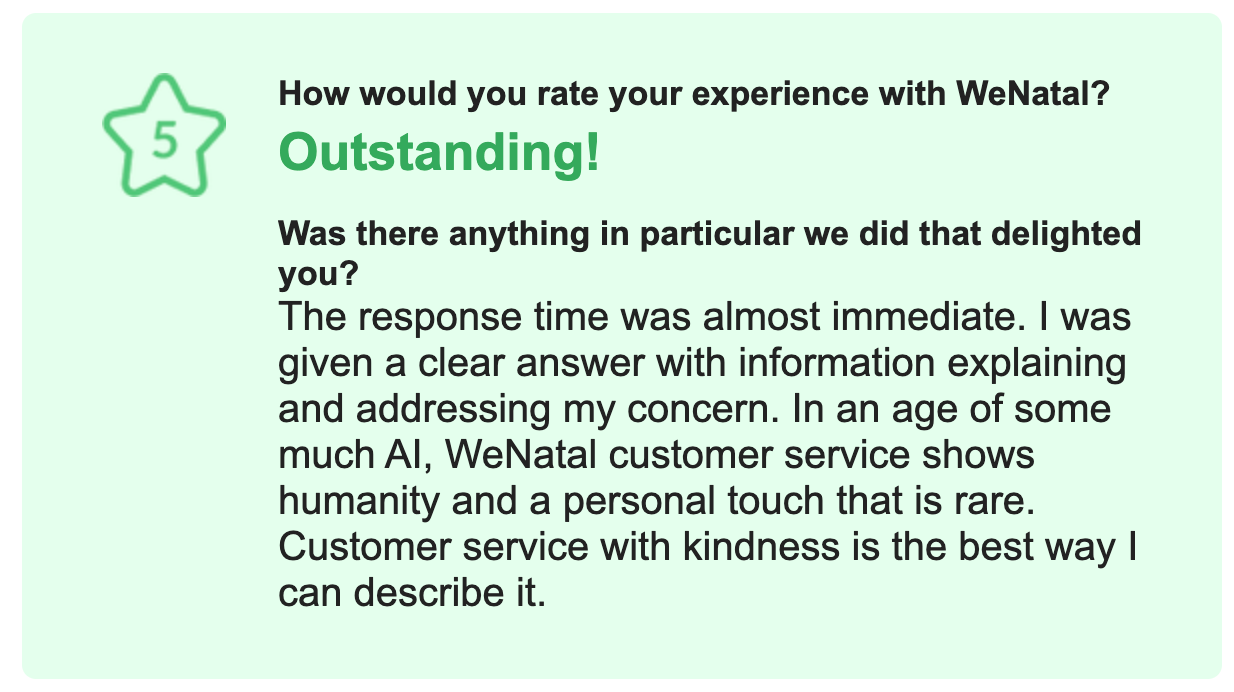
One recent CSAT response captured it.
And sometimes the feedback is more direct than a survey.
Customers send baby shower invitations.
Every journey starts with a question. Where are your customers finding their answers?
See Gladly on your site
Up within days. Smarter with every quarter.
Most AI rollouts take six months to ship and plateau six weeks after. Gladly inverts both. See for yourself.