

August 20, 20267 min read
The best Gorgias alternatives for ecommerce customer service in 2026


Your help desk does more than close tickets. For an online brand, it is often the last touch before someone decides whether to buy again. Gorgias earned its following with tight Shopify integration and order actions built right into the agent view, and for a small store that is a genuinely good start. The trouble tends to show up later, once volume grows and the bill starts moving in ways nobody planned for.
If you are weighing a switch, you are not alone. Support leaders most often cite four things: pricing that climbs with ticket volume, a second charge every time the AI resolves a conversation, reporting that stays shallow, and features that thin out the moment you sell outside Shopify. Here are six Gorgias alternatives worth a serious look in 2026, what each does well, and where each one comes up short.
Why teams outgrow Gorgias
Gorgias charges by billable ticket rather than by seat, which feels friendly when you are small. The catch is that a busy month can push you past your plan, and overage fees stack on top. Its AI Agent adds roughly a dollar per resolved conversation, so a conversation the AI closes can be billed twice, once as a ticket and once as a resolution. Voice and SMS are paid add-ons priced per ticket, not included channels. And reviewers on G2 and Capterra regularly flag two things: reporting that does not go deep enough for larger teams, and feature gaps on non-Shopify platforms, including no AI support for WooCommerce. None of that makes Gorgias a bad tool. It just means a lot of scaling brands eventually want something built for where they are headed.
The best Gorgias alternatives in 2026
1. Gladly, best for brands that want service to drive loyalty and revenue
Gladly takes a different starting point. Instead of organizing everything around tickets, it is built around a lifelong customer timeline, so email, chat, SMS, voice, and social all live in one continuous conversation. Because the platform was designed to be customer-centric from day one, the AI is native rather than bolted on. It resolves common questions end to end, takes real actions like issuing a refund or changing an order, and when a person needs to step in, they inherit the full context instead of asking the customer to repeat themselves. Rothy's grew chat from 2% of its conversation volume to 41% on Gladly, which is what happens when automation makes a channel better rather than harder to reach. Voice is included natively, and pricing is value-based, so it stays predictable when automation succeeds rather than charging you twice. The honest caveat is that Gladly is built for established and scaling brands that treat service as a growth driver, so a brand-new store looking for a ten-dollar plan will find lighter options a better fit. If your goal is to turn support into loyalty and repeat revenue, this is the one to beat.
2. Zendesk, best for large, multi-department organizations
Zendesk is the incumbent for a reason. It is mature, endlessly extensible through a massive app marketplace, and comfortable in large organizations with many departments and strict admin needs. The trade-offs are familiar ones for a ticket-first platform. The AI and advanced reporting often live in higher tiers or add-ons, costs add up as you layer them on, and the whole thing can feel heavy for a lean DTC team that just wants to move fast.
3. Kustomer, best for teams that want a CRM-style timeline
Kustomer pitches a CRM-style timeline that unifies order, loyalty, and shipping data in one view, which resonates with high-volume DTC teams. It is a capable platform for the right buyer. The friction points show up in cost and complexity: per-seat pricing with seat minimums that push the practical entry cost well above the advertised per-user rate, a learning curve that reviewers mention often, and AI that tends to assist the team more than resolve conversations on its own.
4. Help Scout, best for small teams that want simple
Help Scout is the pick when simple is the point. The shared inbox is clean, the tool is quick to adopt, and pricing is fair, which makes it a favorite for small teams that want to sound personal without much overhead. What you give up is depth. Ecommerce-specific automation and advanced AI are lighter here, so a high-volume store is likely to outgrow it.
5. Freshdesk, best for budget-conscious growing teams
Freshdesk is the value play. The entry tiers are affordable, the feature set is broad, and omnichannel support is solid for the price. Just know that the more advanced automation and AI sit behind higher tiers, and the ecommerce integrations are less native than what Gorgias offers out of the box, so plan for some setup.
6. Re:amaze, best for a straightforward per-seat swap
Re:amaze is the closest thing to a like-for-like, per-seat swap. It rolls chat, FAQ, and help desk into one place, supports multiple stores and marketplaces, and keeps pricing straightforward. The ecosystem is smaller than the bigger names and the AI is less advanced, but for a team that wants a familiar shape without ticket-based billing, it is a reasonable landing spot.
Gladly vs. Gorgias at a glance
What matters | Gladly | Gorgias |
|---|---|---|
Pricing model | Predictable, value-based | Per ticket plus per AI resolution |
AI that resolves end to end | Takes actions, not just answers | Resolves common inquiries on email and chat |
Lifelong customer timeline | One thread across every channel | Ticket-based, order data attached |
Native voice | Included | Paid add-on, priced per ticket |
Reporting depth | Built-in analytics | Users cite limited reporting |
Fits beyond Shopify | Channel and platform agnostic | Strongest on Shopify; no AI for WooCommerce |
How to choose the right Gorgias alternative
Start with how you actually run support. If your volume spikes seasonally, weigh how each pricing model behaves at peak, not just at rest. If you lean on automation, ask whether the AI truly resolves a conversation or simply answers and hands off. And if a returning customer reaches out across chat, email, and voice in the same week, ask whether your team will see one relationship or three separate tickets. The right alternative is the one whose strengths line up with your priorities, whether that is simplicity, budget, or turning service into revenue.
It's really impactful that we can have all channels inbound into the same conversation timeline. As you grow your business strategy, Gladly makes it very easy without losing a lot of data and customer insight and that personalization.
Lauren Inman-Semerau
Head of Customer Experience, Rothy's
No single platform wins for everyone. But if you are leaving Gorgias because you want predictable pricing and AI that builds the relationship instead of just closing the ticket, it is worth seeing what a customer-centric platform can do.
Frequently asked questions
Recommended reading
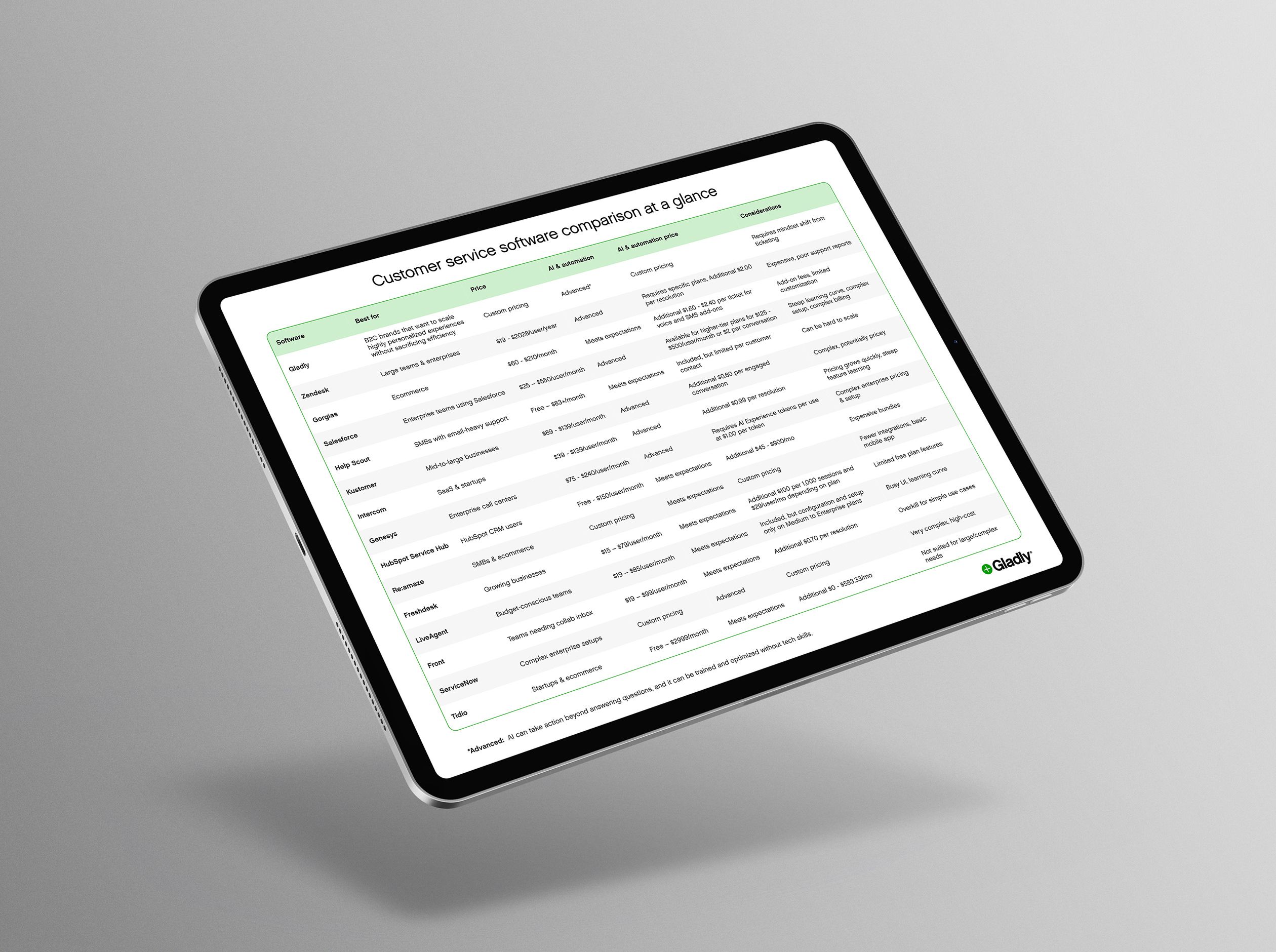
2025 customer service software comparison table (free download)
Choose the right software for your brand with our helpful guide.

Mining your Shopify contact center for revenue gold
Learn how AI surfaces recurring friction points in Shopify support and resolves root causes to reduce tickets while boosting conversion.
By
Aashna Malpani
The deflection trap: why most conversational AI fails to deliver
Most conversational AI fails because companies optimize for deflection, not outcomes. Forrester research reveals why — and what successful adoption looks like.
By
Angie Tran