


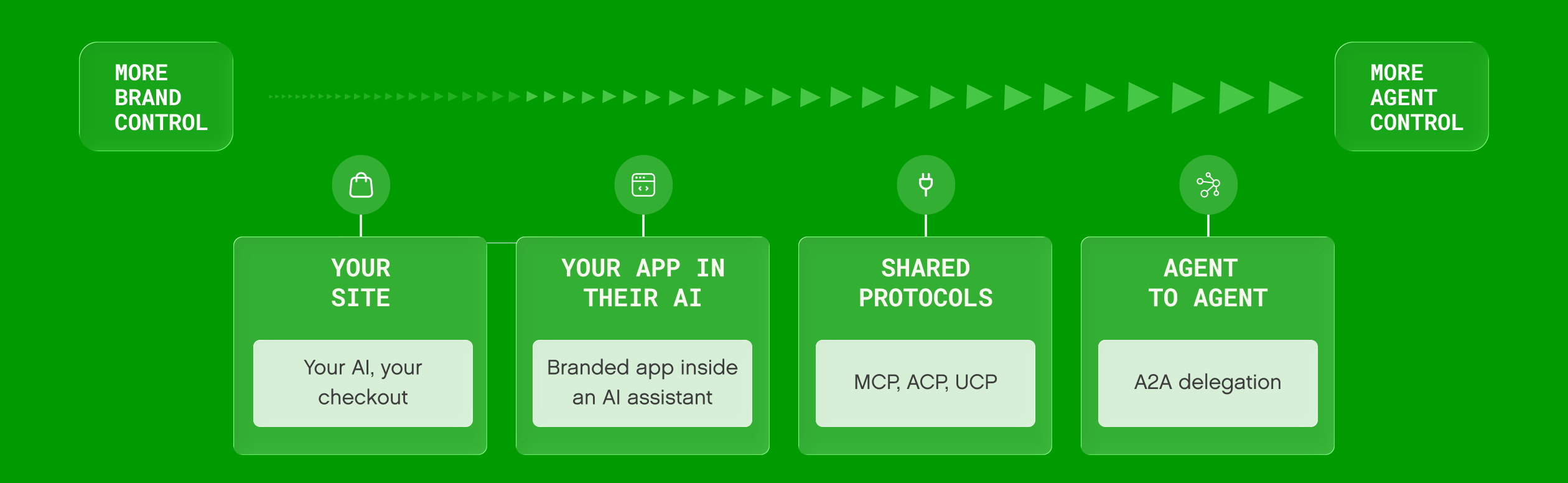
What MCP, ACP, and UCP actually mean for your commerce strategy.
In our previous blog, we made the case that agentic commerce is bigger than shopping agents. It's commerce and service converging into one AI-powered experience that compounds what it knows about the consumer across every conversation. The brands that build for this will generate revenue from conversations they're already having.
But that piece deliberately left a question open: how does any of this actually work? When AI agents start participating in commerce — on your site, on third-party surfaces, across systems — what's the connective tissue? What are the protocols everyone keeps talking about, and which ones matter?
The acronyms are piling up. MCP, ACP, UCP, A2A. This post explains what each one does, how they relate, and where to focus.
Start with the big picture
New to agentic commerce? Read part one to understand why it's bigger than shopping agents — and what it means for your brand.
A familiar strategic question
Before we get into the protocols: the strategic question underneath all of this isn't new.
Every time a new commerce channel shows up — Amazon, Instagram Shopping, Google Shopping — brands face the same tradeoff. How much do you invest in showing up on someone else's platform versus building on your own property? The platforms offer reach. Your own site offers control, margin, and the consumer relationship. Every brand ends up doing both, but the split matters.
AI surfaces are the latest version of that tradeoff. ChatGPT, Gemini, Perplexity — consumers are starting to discover and buy products there. That's real. But the economics are the same as they've always been: those platforms will control discoverability and extract margin over time. They always do.
Early data bears this out. Walmart tested about 200,000 products through ChatGPT's Instant Checkout feature, letting users buy without leaving the chat. Conversion rates were three times lower than when users clicked through to Walmart's own site. Walmart's EVP of product and design called the experience "unsatisfying." OpenAI has since phased out Instant Checkout entirely, shifting toward merchant-controlled app experiences instead. Walmart's response? Embed its own AI shopping assistant, Sparky, directly inside ChatGPT and Gemini — keeping control of the transaction, the consumer data, and the post-purchase relationship.
The takeaway isn't that AI surfaces don't matter for discovery. They do. But the brand that controls the shopping experience controls the conversion. That pattern hasn't changed.
The protocols we're about to walk through are the infrastructure that determines how your brand shows up across all of these surfaces. Understanding them helps you invest in the right order and skip the premature bets.
Try Gladly AI right here
Not sure where to start with agentic commerce? Ask our AI.
Gladly AI already helps shoppers on brand sites. Ask it what it would do for yours.
The spectrum of control
Agentic commerce spans a spectrum, from surfaces you fully control to ones you don't.
On one end: your own website or app, where your AI guides consumers through the full journey. You control the experience, the data, the brand voice.
On the other end: third-party AI surfaces where someone else's AI connects to your systems to fulfill a request. You're present, but you're not in charge.
In between: agent-to-agent, where a third-party AI hands off a task — a return, a complex question — to your brand's AI, which has the context and policies to actually resolve it.
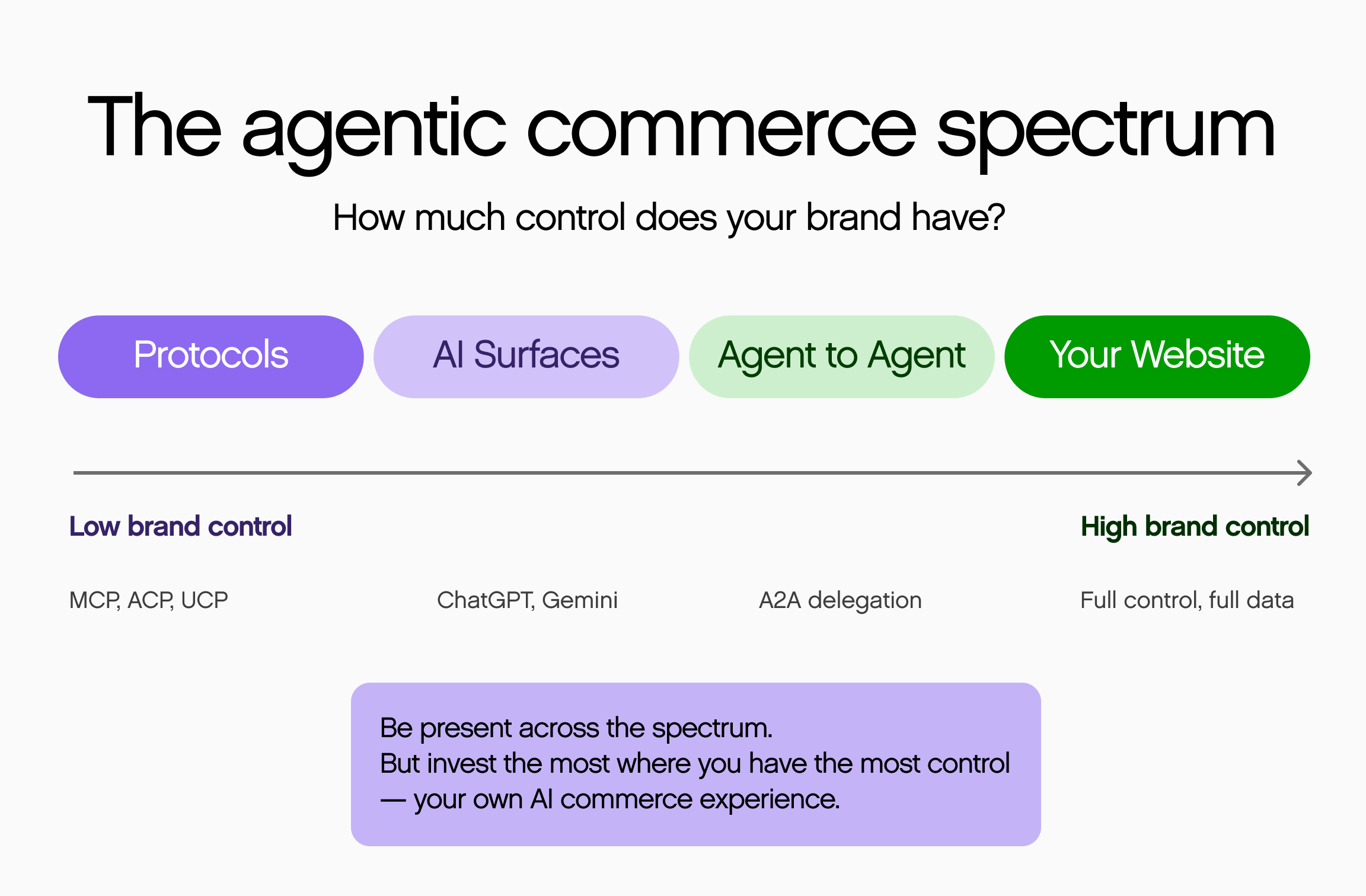
The protocols are what make movement across this spectrum possible. They're the standardized way AI agents connect to your data and capabilities — your product catalog, your order management, your return policies. Without them, every AI surface that wants to connect to your brand needs a custom integration. With them, you build it once.
The protocol landscape
Three protocols worth knowing. They're related but do different things, and the relationship between them is what most coverage gets wrong.
MCP: the universal connector
MCP — Model Context Protocol — is a universal integration standard that defines how AI agents connect to external systems. Anthropic created it. OpenAI, Google, and Microsoft have all adopted it. It's the closest thing to a common language for AI connectivity.
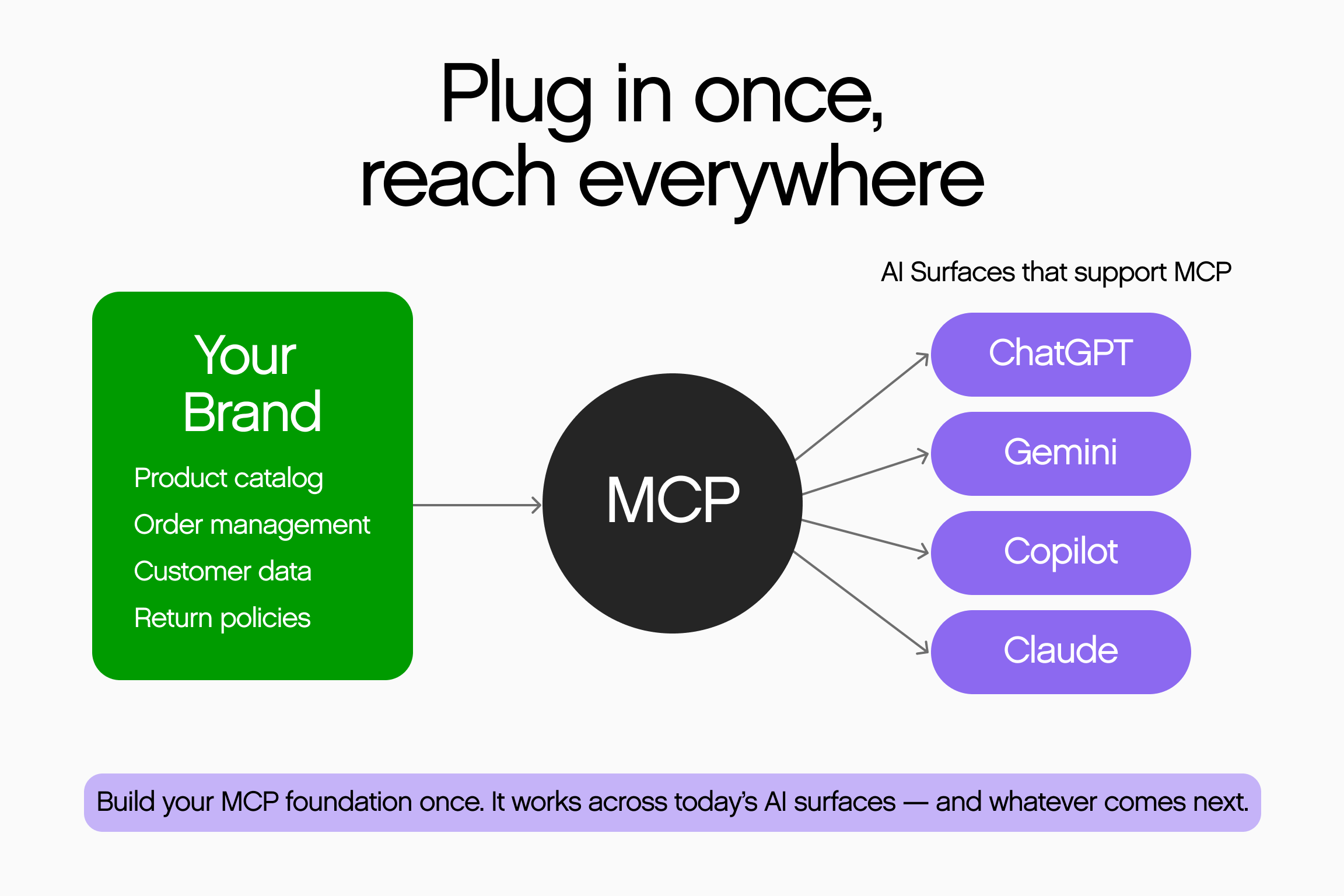
Think of MCP as the electrical outlet. It standardizes the connection point — how tools get described, how AI agents discover them, how they get called, and how responses come back. What you plug into it is up to you. You decide which capabilities to expose — order lookup, product search, return processing — and how to structure them. Any AI agent that speaks MCP can then find and use those tools. ChatGPT, Gemini, Copilot, Claude — they all speak it.
The adoption is real. Shopify has built MCP integration for its merchants. Stripe, PayPal, and Block all have official MCP servers. Thousands of MCP servers exist across the ecosystem. Every major AI provider has shipped support. In December 2025, Anthropic donated MCP to the Linux Foundation's Agentic AI Foundation, with OpenAI and Block as co-founders — a signal that this is shared infrastructure, not a single vendor's project. MCP is production-ready, and it's where you start.
The fragmentation problem
MCP's flexibility is also its weakness. Every brand defines their own tools, so every brand's version of commerce looks different through the protocol.
Say an AI agent is trying to help a consumer compare checkout across three brands. One brand built a tool called "create_checkout_session" that takes an order ID and consumer ID. Another calls it "start_purchase" and expects a cart object and email address. The third uses "initiate_order" with a completely different data structure. All three are valid MCP tools. All three follow the protocol. But the AI has to learn each brand's setup from scratch, and that friction compounds with every new brand.
Multiply that by thousands of brands, each with their own tool designs, and the "universal" connector starts feeling less universal. That's the problem ACP and UCP exist to solve.
ACP & UCP: the appliance standards
If MCP is the electrical outlet, ACP and UCP are the appliance standards — they define what the checkout, the product feed, and the payment handoff should look like so any AI agent can work with any brand.
ACP and UCP are competing commerce-specific standards that work alongside MCP. Same problem, different platforms, different bets on who wins.
ACP — Agentic Commerce Protocol comes from OpenAI and Stripe. It defines how product feeds should be formatted, what a checkout session looks like, how payment processing gets delegated. ACP originally powered OpenAI's Instant Checkout feature, which let users buy products without leaving ChatGPT. That experiment ended in March 2026. Only 8% of US ChatGPT adults tried it, only a dozen Shopify merchants integrated, and OpenAI never built sales tax collection or fraud prevention. OpenAI has since shut down Instant Checkout entirely and pivoted ACP toward product discovery and merchant-controlled app experiences. Major retailers including Target, Sephora, Nordstrom, Lowe's, Best Buy, Home Depot, and Wayfair have integrated ACP for discovery. The early lesson reinforces what the Walmart data already showed: discovery through AI surfaces works, checkout is better left to the brand.
UCP — Universal Commerce Protocol was announced by Google at NRF in January 2026, co-built with Shopify, and supported by Target, Walmart, Wayfair, Etsy, and millions of Shopify merchants. It moved from spec to live faster than anyone expected. In March 2026, Google shipped three capabilities that turned UCP into a functional shopping environment: Cart (multi-item transactions, not just single-item), Catalog (real-time inventory and pricing queries, not static product feeds), and Identity Linking (shoppers get their loyalty pricing and member benefits on UCP-integrated platforms). UCP-powered checkout is now live for eligible US merchants on Google AI Mode and Gemini, with global expansion planned.
As a merchant, you're not choosing between them — you'll likely need both to reach consumers wherever they're shopping. And MCP is still your starting point, not because ACP and UCP are built on top of it, but because it's the one standard that works across every AI platform today, while the commerce protocol wars are still playing out.
Agent-to-agent: where we are headed
One more protocol: A2A — agent-to-agent communication — defines how one AI agent delegates a task to another. As AI use proliferates, it won't just be AI surfaces like ChatGPT delegating to brands. Consumers will increasingly have their own AI agents — personal agents that act on their behalf. Those agents will need to talk to your brand's agent to get things done. Browse inventory, check sizing, ask a question about a product, start a return. The delegation pattern isn't limited to "ChatGPT can't resolve a return." It's any AI agent — a platform's, a competitor's, or the consumer's own — needing a capable brand-side agent to work with.
And here's the thing: a brand with a capable, context-rich AI isn't just better on its own site. It becomes the agent that every other AI routes to when it needs real help. The Walmart example illustrates this in miniature — Walmart is embedding Sparky inside ChatGPT and Gemini rather than letting those platforms run a checkout experience they can't do well. The richer your consumer context, the more value you capture regardless of where the conversation starts.
The A2A protocol, from Google and now managed by the Linux Foundation, defines how this delegation works. The spec is solid, and over 100 companies support it, but major AI surfaces haven't adopted it for consumer commerce yet. Most delegation today happens through simpler mechanisms. As AI commerce matures and consumers start using their own agents, A2A becomes the layer that determines which brands are easy to do business with and which aren't.
Where things actually stand
There's a gap between what gets announced and what's production-ready. Here's the honest picture:
Agentic commerce protocol status
Technology | Status | What it means for brands |
|---|---|---|
MCP | Production-ready | Every major AI provider has adopted it. Shopify, Stripe, and PayPal have live servers. Donated to the Linux Foundation. The foundation layer. |
ACP | Pivoting | Instant Checkout shut down March 2026. Refocused on product discovery and merchant-controlled apps. Major retailers live on discovery. Protocol actively developed — multi-item cart and international expansion planned. |
UCP | Live, US | Went from spec to live transactions in two months. Cart, Catalog, and Identity Linking shipped March 2026. Live on Google AI Mode and Gemini for US merchants. Global expansion planned. |
ChatGPT Apps | Live, growing | Only consumer AI surface with a real app platform. Shifting from in-chat checkout to merchant-embedded experiences. |
A2A | Protocol ready | Solid spec, 100+ supporting companies. Not yet adopted by major AI surfaces for consumer commerce. |
Where this shows up on your own site
All this protocol talk can make agentic commerce sound like something that happens elsewhere — on ChatGPT, on Gemini, in an app you don't control. But the highest-leverage version of it happens on your own site, across four moments in the shopper's path.
Search and discovery. A shopper types "something for a rainy trip to Seattle" instead of three keywords. Agentic search has to interpret that intent, not just match the string, then narrow your full catalog down to a handful of real options.
The product page. Specs and reviews still leave the shopper to do the comparison work. An agent on the PDP can answer "will this fit over a sweater" or "does this run small" directly, using the same catalog and returns data your team already has.
Checkout. This is the one the Walmart and OpenAI numbers above already settled: shoppers convert far better on your own checkout than inside someone else's chat window. Agentic checkout on your own site closes friction instead of handing the sale to a surface you don't control.
Post-purchase. Order status and returns were always half commerce question anyway — "can I swap sizes," "where's my order." An agent that carries context from browsing through purchase into support turns that conversation into a second sale instead of a cost center.
All four need the same foundation: clean product and order data, exposed through MCP, with a capable AI reasoning over it. Which one you build first depends on where your funnel actually leaks, not on which protocol got announced this week.
How to tell if this is your next move
Not every brand should build all four of these right now. Before you commit engineering time, run your funnel through a few questions.
Where is the funnel actually leaking? If it's pre-purchase questions killing your PDP conversion, start there. If it's checkout abandonment, that's your priority regardless of which protocol is dominating the trade press this month.
Are shoppers already asking AI these questions somewhere else? If customers are pasting your product pages into ChatGPT to ask "is this true to size," that's not hypothetical demand. You're already in the conversation — the only question is whether it's happening on your site or someone else's.
Can your team already answer this in one conversation? If team members routinely resolve "will this fit" or "can I swap sizes" without escalating, the knowledge already exists. It just needs to move from a team member's head into something an agent can use.
What does getting it wrong cost you? A bad recommendation on a $30 item is a return. A bad one on a $3,000 item is a lost customer and a support escalation. Size your guardrails, and your first move, to that risk.
Size the opportunity before you commit
Forecasts put US agentic commerce at $190 billion to $385 billion by 2030, but most deployments are still pilots. Get the latest research before you commit engineering time.
If the answers point toward yes, and soon, here's the order that actually works.
How to sequence your investment
If you're looking at this list of protocols and wondering where to start, here's the order that makes sense.
Start with your own AI commerce experience. Not a protocol question — a product question. Build the conversational AI on your own site that goes beyond support into discovery, recommendations, and purchasing. This is where your consumer data compounds, where you control the brand, where the highest-value relationships live. The Walmart data makes this concrete: even the world's largest retailer found that controlling the checkout experience — rather than handing it to a third-party AI — produced dramatically better results. Everything else in this post is about extending that foundation outward.
Get your data in order. Every protocol, every surface, every agent exchange depends on clean, connected data. If your consumer data is scattered across systems, your product catalog is inconsistent, or your conversation history is siloed, no protocol fixes that. Unified consumer context and clean product data come first.
Build your MCP foundation. Expose your product catalog, order data, and service capabilities through MCP. It's the single most practical step toward the distributed side of agentic commerce. Works across every major AI surface today. Positions you for ACP, UCP, and whatever comes next. You're not betting on one protocol — you're building the universal connector that works with all of them.
Align to commerce standards as they solidify. ACP and UCP are no longer theoretical — both have live implementations and major retail partners. ACP is the most tested for product discovery on ChatGPT. UCP is the most advanced for transactions on Google surfaces. Neither has won, and merchants will likely need both. But your MCP foundation means you're not starting from scratch when you adopt either one. Watch which surfaces your consumers actually use and sequence accordingly.
Show up on AI surfaces, with clear eyes. Be present where consumers are discovering products. But treat it like any distributed channel — reach, not the center of your strategy.
The surfaces change, the principle doesn't
Agentic commerce will keep evolving. New protocols will ship, new surfaces will emerge, and the line between where consumers discover your brand and where they buy will keep blurring.
The brands that thrive will invest in both directions — present on the AI surfaces where consumers are starting their journeys, while building AI experiences on their own properties that are worth coming back to. The consumer who discovers you through a third-party AI recommendation and then finds something better on your own site? That's the consumer who stays.

Frequently asked questions
Recommended reading

How AI shopping agents are changing the ecommerce funnel
AI shopping agents are already researching, comparing, and buying on ecommerce sites. Here's what that means for your product pages, pricing, and reviews.
By
Gladly Editorial

Why agentic AI is the next big thing
Discover agentic AI: customer service that acts! Explore how agentic AI automates complex tasks, empowers CX teams, and delivers personalized experiences.
By
Angie Tran

The trust layer: what brands must build before AI agents shop for customers
Why agentic commerce will only work for brands that architect AI around trust — with continuous context, shared human–AI conversations, and real guardrails.
By
Nidhi Nair