


Most advice on bundling stays abstract: pair complementary products, offer a discount, watch average order value climb. That’s fine as far as it goes, but it’s hard to act on until you’ve seen how real stores set their bundles up. We went and looked, and below are 10 product bundling examples from ecommerce and DTC brands, with what’s in each bundle, how the savings work, where the store shows it, and one thing worth borrowing.
Prices and savings are what each brand’s site showed in October 2026, and they change, so treat them as a snapshot. If you want the full playbook on building bundles, from picking products to measuring results, our product bundling strategy guide covers it, and we link to the matching section of it as we go.
10 product bundling examples from ecommerce brands
1. Caraway sells the same cookware in sets from six pieces to 31
Caraway’s cookware sets come in preset sizes that run from a six-piece starter up to a 31-piece kitchen, all on one product page. The 12-piece set showed “Save $230 (34% off),” and add-ons sit on the same page, so you can grow the bundle without leaving it.
Bundle type: curated, discounted.
Where it’s shown: one product page with a set-size picker and add-ons.
What to borrow: put every set size on one page with a size picker. The shopper compares sets side by side and never has to decide between separate product pages. The strategy guide’s section on bundles on product detail pages goes deeper on this layout.
2. Our Place states bundle savings in dollars
Our Place sells curated cookware bundles like the Cookware Set+ and the Titanium Always Pan Duo. The savings are stated in dollars: $217 on the Cookware Set+ and $78 on the duo.
Bundle type: curated, discounted.
Where it’s shown: each set has its own product page.
What to borrow: a dollar figure next to a cookware set is easier to weigh than a percentage, because the shopper can picture what $217 buys. If your bundles are big-ticket, lead with the dollar amount.
3. Blume turns a skincare routine into one purchase
Blume’s bundles page sells its Ultimate Clear Skin Routine as a single product, priced at $95, down from $192, and the same page carries holiday kits.
Bundle type: curated, seasonal.
Where it’s shown: a dedicated bundles collection page.
What to borrow: a routine is a natural bundle because the shopper already thinks of the products as steps that go together. If you sell anything with an order of use, package the whole sequence and name it after the result.
4. Brooklinen builds a bundle ladder
Brooklinen’s bundles page, headed “Bundle Savings,” lays out a ladder. Core Sheet Sets include a fitted sheet, a flat sheet, and two pillowcases. The Starter pairs a sheet set with a bed blanket, the Hardcore adds a duvet cover and bumps you to four pillowcases, and the Move-In adds a comforter and two pillows on top of that. There are duvet and quilt sets too, and shoppers choose their own colors and patterns under the line “Mix. Match. Save. Sleep.” Savings on the page ran from 20% off a Core Sheet Set to up to 50% off Duvet & Quilt Sets.
Bundle type: good-better-best tiers, occasion-based, mix-and-match.
Where it’s shown: a dedicated bundles page.
What to borrow: the Move-In bundle is named for a moment in the customer’s life. Someone furnishing a new apartment doesn’t want to assemble a bedroom item by item, and a bundle named for that job is the one they’ll reach for.
5. Harry’s runs the same bundles across two product lines
Harry’s Bundles & Sets page repeats one lineup for its Plus and Original razors, from a starter Shave Set up to a year’s supply, and “Bundles & Sets” has its own spot in the top nav. When we looked, the Plus Shave Set was $20, down from $27, with a “25% Savings” badge. The Plus Value Pack had the same $27 to $20 drop with a “Save $7” badge, and the Plus Annual Plan was $77, down from $102, with “Save $25.”
Bundle type: tiered by product line, volume, prepaid annual.
Where it’s shown: a Bundles & Sets page with its own nav item.
What to borrow: look at the two $20 products. Same price, same discount, and one shows a percentage while the other shows dollars. We can’t tell you why Harry’s chose each, but it’s a cheap test you can run on your own bundles. The guide’s section on discounted bundles covers how deep to go.
6. Bombas lets you build a sock pack from the product page
Bombas links to Build a Pack & Save from its Women and Men menus. The more interesting part is on the single-sock product page. A women’s ankle sock was $14.50 on its own, and the same page has 4-, 8-, and 12-pack options, with “Save 10% on 4+ Singles.”
Bundle type: build-your-own, volume discount.
Where it’s shown: the main menus and the single-item product page.
What to borrow: the shopper who came for one pair sees the pack option without going anywhere. If you sell a consumable or a basic people buy more than one of, put the multi-pack on the single-item page. The strategy guide explains how mix-and-match bundles differ from fixed ones.
7. Parachute lets shoppers design their own bedding bundle
Parachute sells custom bundles in both linen and percale, and the custom linen bundle lets you build your own set and takes 15% off.
Bundle type: build-your-own, discounted.
Where it’s shown: a dedicated bundle product page.
What to borrow: a flat percentage on a custom bundle is easy to understand and easy to run. The shopper gets control over what’s in the set, and you get a bigger basket without having to guess which combination everyone wants.
8. Glossier offers a custom set and ready-made holiday sets
Glossier sells a custom skincare set that you build yourself from three to five products, at 10% off, alongside ready-made holiday sets like the You Duo.
Bundle type: build-your-own, seasonal.
Where it’s shown: a custom-set page plus holiday sets.
What to borrow: running both formats at once covers two kinds of shopper. Someone who knows their routine builds a custom set, and someone buying a gift picks the set that’s already done.
9. Graza uses a starter kit to start a subscription
Graza’s Starter Kit pairs its Sizzle & Drizzle Duo with a set of refill cans and a funnel for refilling. Once the first bottles run dry, the page points shoppers to a refill subscription.
Bundle type: value-add, subscription onboarding.
Where it’s shown: its own product page.
What to borrow: the funnel is the clever bit. It’s cheap to include, it’s only useful if you plan to refill, and it nudges the first-time buyer toward the subscription. That’s a value-add bundle doing two jobs at once.
10. Tsuno builds bundles around what the customer needs
Tsuno, an Australian period care brand, sorts its bundles by need: pads-only packs for light, medium, and heavy flow, a tampons-only bundle, mixed packs, and “a bit of everything.” Every bundle is 10% off, and every bundle includes one box donated to a local charity. The page is headed “Save Time, Save Money, Do Good,” and the copy promises “no decision fatigue.”
Bundle type: needs-based curation, cause-based value-add, flat discount.
Where it’s shown: a bundles collection page.
What to borrow: naming bundles by the customer’s situation tells shoppers which one is theirs. “Heavy flow” gets them there faster than any product grid could.
Product bundling examples compared
Brand | Bundle and price when we looked | Type and placement |
|---|---|---|
Caraway | Cookware sets, 6–31 pieces; 12-piece set “Save $230 (34% off)” | Curated, discounted; one product page with a size picker |
Our Place | Cookware Set+ and Titanium Always Pan Duo; $217 and $78 in set savings | Curated, discounted; set product pages |
Blume | Ultimate Clear Skin Routine, $95 down from $192; holiday kits | Curated, seasonal; bundles collection |
Brooklinen | Core, Starter, Hardcore, and Move-In bedding sets | Good-better-best, occasion-based; bundles page |
Harry’s | Shave Set to Annual Plan; Plus Annual Plan $77 down from $102 | Tiered, volume; Bundles & Sets nav item and page |
Bombas | Custom sock packs of 4+ pairs, 10% off | Build-your-own; main menus and product page |
Parachute | Custom linen and percale bundles, 15% off | Build-your-own; bundle product page |
Glossier | Custom skincare set of 3–5 products, 10% off; You Duo holiday set | Build-your-own, seasonal; custom-set page |
Graza | Starter Kit: Sizzle & Drizzle Duo, refill cans, and a funnel | Value-add, subscription; product page |
Tsuno | Needs-based period care bundles, 10% off, donated box | Needs-based, cause-based; bundles collection |
A few patterns show up across the list. Discounts cluster around 10% to 15% for build-your-own and climb higher for curated sets. Bombas and Harry’s both give bundles a spot in the navigation, where shoppers see them before they’ve picked a single product. And a couple of them, like Graza with its refill subscription and Harry’s with its annual plan, use the bundle to set up the next order.
What a bundle does to AOV and margin, a worked example
Every discount in that table comes out of margin, so it’s worth running the math before you copy one. The numbers below are made up to show how it works. Swap in your own.
Say your best seller is a $60 product that costs you $27, so you make $33 on each one. You add a $30 accessory that costs $12 and sell the two together at 15% off, so the bundle is $76.50. It costs you $39, which leaves $37.50 in gross profit. Your margin rate drops from 55% to 49%, but you make $4.50 more per order than you did on the best seller alone.
Now run it across 1,000 orders where 20% of shoppers take the bundle.
If none of those 200 shoppers would have bought the accessory anyway, revenue goes from $60,000 to $63,300, so AOV rises from $60 to $63.30, about 5.5%. Gross profit goes from $33,000 to $33,900, up $900.
Change one assumption. Say 50 of those 200 shoppers would have bought both products at full price without the bundle. Your old AOV was already $61.50, so the bundle only lifts it 2.9%, and gross profit lands at $33,900 either way. AOV went up and you made nothing extra, because you gave a discount to 50 people who didn’t need one.
To catch that, track attach rate, gross margin per order, and how many bundle buyers were already buying both items before you launched it. The strategy guide walks through how to run the margin math before you pick a discount and how to measure bundle performance beyond AOV, and our guide on how to increase average order value covers the other levers worth testing alongside bundles.
Bundles built in a support conversation
Every example above is a bundle the brand decided on in advance. Some of the best bundles get built on the spot, when a shopper asks a question and the person or AI answering knows enough to suggest the right second item.
KÜHL, the outdoor apparel brand, saw this happen once its team members stopped racing to close tickets and had time to talk about the product.
Before, because the agents were so worried about bringing down that ticket number, they really didn’t care to talk about our product or do any kind of a sale. And now I hear them making upsells and giving tailored advice.
Nancy Orgill
Customer Support Manager, KÜHL
That change showed up in the numbers. After moving to Gladly, KÜHL saw a 120% increase in revenue per call. Team members could see each customer’s purchase history and current orders in one profile, so suggestions could start from what that person had already bought.
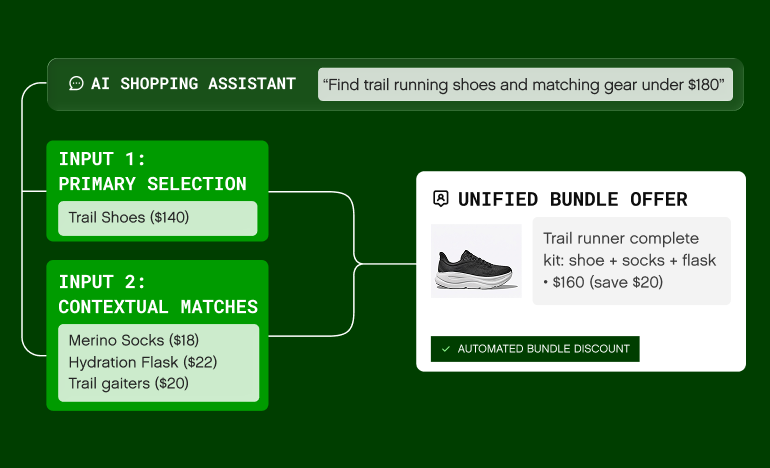
AI can do the same thing in chat. An AI shopping assistant like Gladly recommends products from the customer’s full history, including their sizes, their styles, and everything they’ve bought before. Checkout happens in the conversation without a redirect, and a person is one tap away when the purchase is a big one. A bundle built this way fits one shopper, which no preset set can do. For more on how assistants handle add-ons, see the complete-the-look section of our AI shopping assistant guide, and for the wider picture, our post on website personalization covers personalizing one-to-one in the conversation. The strategy guide also has a short section on personalized bundles assembled in the conversation.
Try Gladly AI right here
Ask Gladly how it builds bundles in a conversation
This is Gladly AI, the same assistant our customers put on their own sites.
Frequently asked questions
Recommended reading
How to build a product bundling strategy that moves the AOV needle
Pick the right products, price bundles without giving away margin, merchandise them on PLP, PDP, and cart, and measure what they really earn.
By
Gladly Editorial
How to increase average order value, a practical playbook for ecommerce teams
A practical AOV playbook for ecommerce teams, covering upsells, cross-sells, free shipping thresholds, bundles, mobile fixes, and how to measure lift with RPV.
By
Gladly Editorial

What an AI shopping assistant does and how to choose one for your store
How AI shopping assistants work, what Smith Optics, Tecovas and KÜHL saw, and how to choose and measure one for your store.
By
Gladly Editorial