
February 8, 2026
The contact center is disappearing. Here's what replaces it.
There's a phrase buried in recent Forrester research that should get the attention of every CX leader: "The concepts of a 'customer service agent' or a contact center with cubicle farms and a captive workforce will be terms of the past."
This assessment comes with a timeline. Leading companies will achieve partial agentic capabilities in customer service within 20 to 28 months. Full transformation? Five years or more.
The shift is already underway.
What "agentic" actually means for CX
The term getting thrown around is "agentic business fabric," an architectural shift where AI agents don't just assist with tasks but orchestrate entire workflows across systems, data, and human expertise.
In customer operations specifically, this means AI handling routine work while humans focus on complex exceptions, creative problem-solving, and relationship management. The role shifts from "agent who handles tickets" to "automation supervisor who optimizes AI based on enterprise goals."
This is about fundamentally changing what people do, not replacing them.
The dangerous middle
Here's what the Forrester research gets right: the transition period is treacherous.
Companies are already experiencing fragmented AI deployment — redundant assistants with different interfaces and capabilities, deployed without central governance, creating confusion instead of productivity gains. New automated workflows clash with manual processes. Data governance becomes a nightmare.
This is what happens when you bolt AI onto legacy systems instead of architecting for an agentic future from the start.
The companies navigating this well are the ones with strong governance frameworks, unified data architectures, and a clear vision for how humans and AI work together.
Why data architecture is the real differentiator
The fragmentation problem doesn't stop at governance. It extends to the data itself.
The research makes a critical point: AI agents need contextually rich data to interpret, reason, and act in a trusted manner. Raw data locked in application silos won't cut it.
This is where most CX technology falls short. Systems built around tickets — isolated transactions disconnected from customers — can't provide the context AI needs to make good decisions. Every interaction starts from scratch because the system doesn't know who it's talking to or why that matters.
The alternative is building around the customer from the start. Every conversation, every channel, every interaction contributing to a unified understanding that AI can actually use. Not just for efficiency, but for the kind of contextual, relationship-aware service that builds loyalty.
The human-AI partnership model
The most interesting prediction in the research isn't about technology, but about people.
In the fully realized agentic enterprise, AI handles routine operations while humans focus on strategic decisions, creative problem-solving, and relationship management. Technology becomes invisible. Users focus on outcomes, not interfaces.
This is the opposite of how most companies are deploying AI today. The current approach treats AI as a way to deflect customers and reduce headcount. The future approach treats AI as a way to elevate what humans can do.
But when AI operates without that human partnership, the limits show. The Gladly 2026 Customer Expectations Report found that 88% of customers get their issues resolved through AI, but only 22% said the experience made them prefer the company. Resolution without relationship is a losing strategy. The companies that win will be the ones building AI that strengthens customer connections, not just closes tickets.
What this means now
The Forrester research is clear that this transformation is a present-day strategic imperative, not a distant forecast. The companies that wait will find themselves managing increasingly complex legacy systems while competitors operate with unprecedented agility.
But the path forward isn't a massive overhaul. It's deliberate moves: getting data architecture right, establishing governance frameworks, building the human-AI collaboration models that actually work.
The contact center as we know it is ending. What replaces it depends entirely on whether companies optimize for efficiency alone — or for the customer relationships that drive lasting business value.

Recommended reading
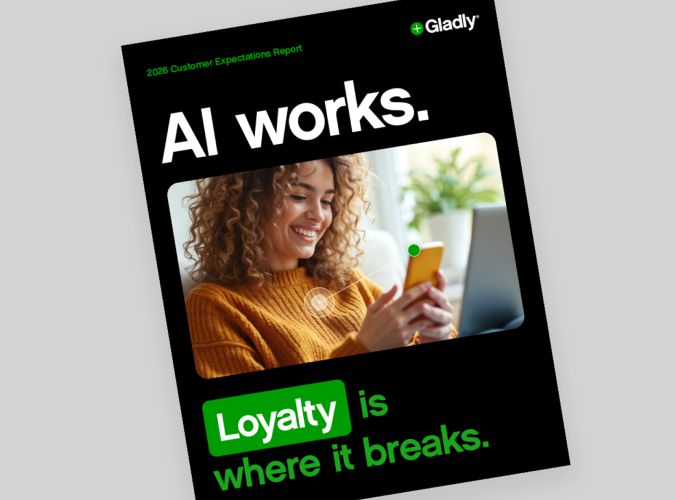
2026 Customer expectations report
New national study: Customers now start with AI, but poor experiences drive defection, even when problems get solved. Download the data.

Retail's biggest priority is also its biggest gap
65% of retailers say CX is their top priority. So why is CX quality declining? The gap between investment and impact is an architecture problem.
By
Angie Tran

Buy vs. build AI checklist
Should you build or buy AI for customer service? This CIO checklist covers costs, risks, and vendor evaluation to help you decide wisely.