
February 8, 2026
Why 95% of AI projects fail—and what CX teams are getting wrong
Here's a stat that should make every CX leader pause: a recent MIT analysis of 300+ public AI project announcements found that 95% failed to create "marked and sustained productivity and/or P&L impact."
Ninety-five percent.
This is a strategy problem, not a technology problem.
New Forrester research on AI's role in customer retention and advocacy reveals why postsale teams—customer success, customer service, customer marketing—are struggling to see real results from their AI investments. And buried in the data is a pattern that explains the failure rate: companies are optimizing for one dimension of value while leaving the other on the table.
Resolution without relationship
The industry celebrates AI wins in a specific way: automatic query resolution rates, deflection percentages, cost-per-contact reductions. One company reports 65% automatic query resolution. Another hits 90% with top-performing teams. These are real efficiency gains.
But here's the question nobody's asking loudly enough: What happened to those customers after their issue was resolved?
The 2026 Gladly Customer Expectations Report found that 88% of customers get their issues resolved through AI. But only 22% say the experience made them prefer the company.
That's a 66-point gap between resolution and relationship.
Resolution rates matter, but they're the floor, not the ceiling. When AI is architected purely around ticket deflection, you're optimizing for one outcome while systematically underinvesting in another: the customer relationship that drives lifetime value.
The employee resistance no one wants to talk about
There's another uncomfortable truth emerging from the research: the people you need most for AI adoption are the ones most threatened by it.
Support engineers and customer service agents are precisely the teams you need on board as you put AI to work. But when companies cut thousands of jobs citing AI adoption, the message to frontline teams is clear: AI is here to replace you, not empower you.
The result is natural resistance. Hesitation to adopt. Skills gaps that widen because people aren't invested in learning tools designed to eliminate their roles.
Consider: according to Forrester, only 35% of companies offer training on making decisions with AI models. A mere 23% train on prompt engineering. This is what happens when AI strategy starts with cost savings and ends with cost savings—efficiency becomes a weapon against your own team rather than a capability that elevates what they can do.
What "getting AI right" means
Companies should build AI that delivers efficiency and customer value together.
Some teams use AI to prep for customer interactions—pulling previous interactions, support tickets, product histories, and usage data to give agents complete context before a conversation even starts. One enterprise example in the Forrester research shows engineers saving 15 minutes to an hour per case this way. That's efficiency and better customer experience and an empowered team.
Others use AI coaching as a real-time sounding board, bringing together information from across the organization to help agents reach better outcomes. Instead of treating AI monitoring as unwanted oversight, teams use it to shorten learning curves and improve customer conversations.
These are augmentation plays, not deflection plays—AI designed to make humans more effective rather than make humans unnecessary.
The measurement problem beneath everything
When you measure deflection rates, you get deflection. When you measure resolution rates, you get resolution. Neither tells you whether you're building or spending relationship equity with every interaction.
The teams breaking through are adding devotion metrics alongside efficiency metrics: CSAT, customer effort score, retention, revenue growth, share of wallet. They're asking not just "did we resolve this?" but "did this interaction make the customer more likely to stay, buy more, and tell others?"
That's the shift from AI as cost center to AI as business driver.
Efficiency is the foundation, not the finish line
The practical advice is sound: start with smaller, limited-scope projects. Make data and content ready for AI use cases. Design explainability into your approach. Increase employee AI literacy through hands-on use. Document benefits and limitations with hard data.
All of that matters. But none of it works if you're optimizing for the wrong outcome.
The 95% failure rate reflects what happens when AI success is defined as "work eliminated" rather than "customer outcome quality." It's the natural result of treating efficiency as the entire strategy instead of the foundation for something bigger.
Deflection saves money, and devotion makes money. Build for both.

Recommended reading

New CIO? Your CX stack will tell you everything
The most revealing move a new CIO can make has nothing to do with admin access. Call your support line. File a ticket. See what happens.
By
Angie Tran

Buy vs. build AI checklist
Should you build or buy AI for customer service? This CIO checklist covers costs, risks, and vendor evaluation to help you decide wisely.
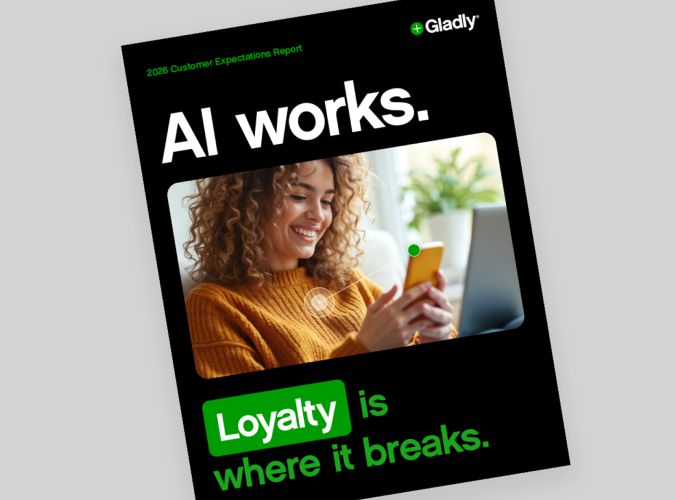
2026 Customer expectations report
New national study: Customers now start with AI, but poor experiences drive defection, even when problems get solved. Download the data.