
February 8, 2026
The deflection trap: why most conversational AI fails to deliver
The pitch is always the same: implement conversational AI, automate a chunk of your inbound volume, reduce costs. It sounds straightforward. And with 74% of online adults saying they prefer self-service for tasks like making a payment, the demand is clearly there.
So why do so many conversational AI initiatives fail to deliver?
Forrester's Buyers Guide for Conversational AI offers a blunt assessment: despite promising advances, companies continue to rapidly adopt AI solutions only to fail at creating useful experiences for employees or customers. Adoption remains more complicated than most organizations are prepared for.
The problem is rarely the technology, but the objectives.
The pattern to avoid
You see it all the time — organizations prioritize deflection over customer success, funneling all users through an automated mechanism. The result is a recipe for failure.
Why? Because when AI doesn't actually help, people find workarounds. Employees evade official channels. Customers abandon the bot and call anyway — or worse, they abandon the brand entirely.
Forrester is direct about this: if customers aren't satisfied, you won't see ROI.
This is the deflection trap. You optimize for the metric that looks good on a dashboard — conversations handled by AI — without asking whether those conversations actually resolved anything. The automation rate goes up. Customer sentiment goes down. And the business case falls apart.
Gladly consumer research (2026): 88% of customers said their issue was resolved through AI, yet only 22% said the experience made them prefer the company. Resolution is not the same as loyalty.
What success actually looks like
Forrester lays out specific benchmarks for conversational AI initiatives. Within six months of implementation, organizations should expect to automate 20% of inbound requests, reduce mean time to resolution by more than 20%, and improve customer satisfaction. The breakeven point should come within 12 months.
Multiple customers in the research reported automating 30% to 40% of inbound volume. But here's the key detail: those results didn't always mean staff reductions. Instead, they allowed teams to meet latent demand, reduce resolution times, and improve satisfaction scores.
The wins came from making service better, not just cheaper.
The integration problem
Even organizations with the right objectives run into a common obstacle: integration. It’s the most frequent challenge adopters face. Connecting conversational AI to other systems still requires trial and error, and getting AI to execute complex requests that span multiple systems remains difficult.
This matters because context is everything. To answer a customer's question appropriately, AI needs to know both the answer and the surrounding context. What did this customer order? What's their history? What are they actually trying to accomplish?
Without that context, even a technically capable AI gives generic responses. And generic responses don't build loyalty.
The web of bots problem
There's another failure mode worth flagging: customers having to navigate a web of bots. When organizations deploy fragmented AI solutions across different touchpoints — one for sales, one for support, one for returns — the customer experience suffers.
People don't think in terms of departments, but in terms of their problem. When they have to figure out which bot handles what, or repeat themselves across channels, the efficiency gains disappear into frustration.
Gladly consumer research (2026): 47% say they won't buy again after a bad handoff, and 48% abandon when they're forced to repeat themselves.
AI designed to build lasting value
Before investing in conversational AI, the question isn't "how much can we automate?" It's "what experience do we want customers to have — and will this help us deliver it?"
That means measuring satisfaction alongside deflection. It means ensuring AI has the customer context to personalize responses. It means thinking about orchestration across the entire journey, not just individual touchpoints.
The organizations getting this right are building AI that delivers efficiency and experience together — automation that actually resolves issues and leaves customers feeling served, not shuffled.
Gladly consumer research (2026): Consumers are nearly twice as likely to take a loyalty action after a smooth AI-to-human handoff than after an AI-only experience.
That's the difference between AI designed to deflect and AI designed to build lasting value.

Recommended reading

New CIO? Your CX stack will tell you everything
The most revealing move a new CIO can make has nothing to do with admin access. Call your support line. File a ticket. See what happens.
By
Angie Tran

Retail's biggest priority is also its biggest gap
65% of retailers say CX is their top priority. So why is CX quality declining? The gap between investment and impact is an architecture problem.
By
Angie Tran
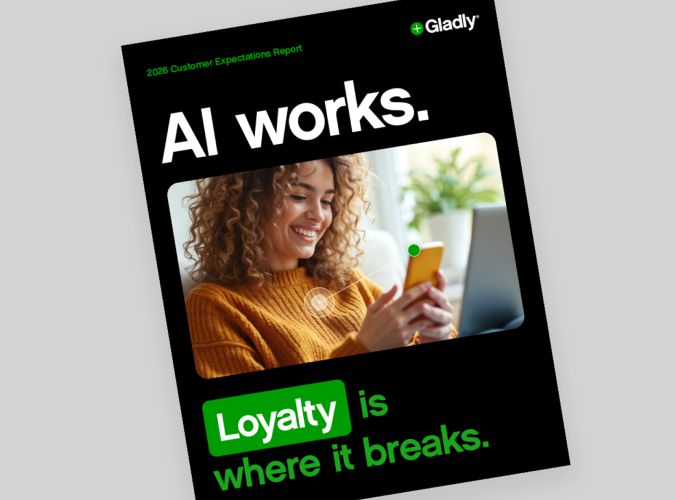
2026 Customer expectations report
New national study: Customers now start with AI, but poor experiences drive defection, even when problems get solved. Download the data.