
March 23, 2026
Best Shopify integrations for 2026: How to build a tech stack that works together
What's better than hiring a web designer to give you the online ecommerce platform of your dreams? Using Shopify, of course.
But here's where most stores get stuck: they add apps one by one, solving individual problems without thinking about how those apps work together. You end up with a customer service platform that doesn't talk to your email tool, a loyalty program your support team can't see, and shipping data that never makes it back to your CRM.
The result? Your team jumps between six different systems to help a single customer. Customer context gets lost. Efficiency suffers. And the customer experience fragments across every touchpoint.
The solution isn't fewer apps—it's smarter integrations. The best Shopify stores don't just add tools. They build integrated systems where every app makes the others more effective.
This guide shows you which Shopify integrations actually work together, organized by how they connect rather than just what they do.
What are Shopify integrations?
A Shopify app is a standalone tool that adds specific functionality to your store. A Shopify integration is how that app connects with your other systems to share data and automate workflows.
The distinction matters because apps solve point problems, but integrations create compounding value.
Example: The difference in practice
You install a customer service app. It lets your team respond to inquiries. That's the app working.
Now that app pulls order history from Shopify, syncs customer segments from Klaviyo, displays loyalty points from LoyaltyLion, and triggers post-purchase flows based on resolution outcomes. That's integration working.
The first scenario means your team can answer questions. The second means every conversation builds on complete customer context and feeds insights back into your entire tech stack.
Native vs. third-party integrations
Native integrations are built directly into apps and require minimal setup. The Gladly native Shopify integration automatically pulls order data, customer history, and lifetime value directly into every conversation. Your team sees everything without leaving the platform.
Third-party integrations require middleware like Zapier or custom API connections. These work, but they add complexity and potential failure points. When evaluating apps, prioritize native integrations with the systems you already use.
Why integration architecture matters
Most stores think about apps individually: "I need a loyalty program" or "I need better shipping." That leads to a fragmented tech stack where data lives in silos.
Instead, think about integration paths: "How will my support team access loyalty data?" and "How will shipping updates trigger email campaigns?"
The best Shopify stores plan their tech stack around three integration hubs.
The 3-hub framework for Shopify integrations
Before you add another app, understand how your tech stack should be architected. Every successful Shopify store builds around these three integration hubs:
1. Customer data hub
Usually, your customer service platform or CDP where all customer context lives. This becomes your single source of truth for who your customers are, what they've purchased, and how you've helped them.
2. Marketing automation hub
Usually, your email and SMS platform, where campaigns and flows originate. This hub turns customer behavior into automated retention marketing.
3. Operations hub
Usually, your order management or fulfillment system, where logistics happen. This hub keeps inventory accurate and shipments moving.
Every app you add should connect to at least one hub. If it doesn't, you're creating another silo.
The framework changes how you evaluate apps. Instead of asking "Does this app solve my problem?" you ask "How does this app share data with my existing hubs?"
For stores ready to scale intelligently, understanding how to evaluate Shopify apps through an integration lens is essential.
Core integration: Customer service as your data hub
Your customer service platform is the natural center of your tech stack because that's where all customer conversations happen. When this hub integrates deeply with Shopify and your other systems, your team can resolve issues faster and identify opportunities that drive revenue.
Gladly: Built for integration
Rating: 4.7/5 (27+ reviews on Shopify App Store)
Pricing: Custom pricing based on team size
Best for: Stores with 2+ support team members needing unified customer context
Gladly is purpose-built around integration. The platform pulls critical information—customer history, lifetime value, order details, loyalty status—from Shopify and your other tools directly into every conversation.
What makes the integration different
Our native Shopify integration is bidirectional. Your team sees complete order history and can take action—process refunds, cancel orders, issue discount codes—without leaving the conversation. No tab-switching. No copy-pasting order numbers. No asking customers to repeat information.
Why this matters
When your support platform connects to everything else in your stack, every conversation becomes more informed. Your team knows whether someone is a VIP subscriber, whether they've had issues before, which products they love, and where they are in their customer journey. That context changes how you help them.
Integration ecosystem
Klaviyo: Sync customer data and conversation outcomes to trigger targeted campaigns
LoyaltyLion: See points balance and tier status during conversations
Loop Returns: Process returns without leaving the platform
Recharge: Manage subscription changes directly in support conversations
ShipStation: View tracking and delivery status in real time
Want to see the full picture of what Gladly's latest integrations including Shopify can do?
The platform connects with your entire ecommerce ecosystem.
Customer service impact
Gladly AI-powered automation resolves customer conversations around the clock. Shopify merchants report dramatic improvements in operational efficiency while maintaining personalized service quality. When support becomes your integration hub, it stops being a cost center and becomes a revenue driver.
Marketing stack integration
Your email and SMS platform becomes more powerful when it can trigger campaigns based on support outcomes, subscription changes, and loyalty milestones—not just purchase behavior.
Klaviyo: Data-driven email and SMS automation
Rating: 4.5/5 (2,570+ reviews)
Pricing: Free for up to 250 contacts; paid plans start at $20/month
Best for: Growing ecommerce brands focused on customer lifetime value
Klaviyo builds sophisticated marketing automation using deep Shopify integration. Every purchase, browse, and cart abandonment becomes a trigger point for personalized campaigns.
Integration strength
Klaviyo's real power shows up when it connects to your support and loyalty systems. When Gladly resolves a customer issue, that outcome can trigger a follow-up campaign. When LoyaltyLion reports a customer hit VIP status, Klaviyo sends a celebration email. When Recharge processes a subscription renewal, Klaviyo recommends complementary products.
Works with: Gladly, Judge.me, LoyaltyLion, Recharge, Rebuy
Omnisend: Multichannel marketing made simple
Rating: 4.7/5 (2,900+ reviews)
Pricing: Free plan available; paid plans start at $16/month
Best for: Growing stores wanting multichannel marketing without complexity
Omnisend combines email, SMS, and push notifications into unified campaigns with pre-built automation workflows synced to your Shopify data.
Integration strength
Omnisend's drag-and-drop automation builder makes complex multichannel campaigns accessible without technical skills. The platform costs significantly less than Klaviyo while delivering enterprise features. Merchants report 30% cost savings while maintaining sophisticated automation.
Works with: Shopify, Gladly, Judge.me, Recharge
Conversion and personalization integration
These tools capture visitors and increase average order value—but they work best when integrated with your customer data and marketing systems.
OptiMonk: Smart popups and personalized experiences
Rating: 4.6/5 (430+ reviews)
Pricing: Free plan available; paid plans start at $29/month
Best for: Brands focused on conversion rate optimization
OptiMonk creates targeted popups and on-site experiences that capture emails and reduce cart abandonment. AI-powered recommendations suggest the right message at the right time.
Integration strength
OptiMonk's captured leads sync directly to Klaviyo, HubSpot, or Mailchimp, automatically entering new subscribers into your welcome flows. The platform can also display personalized content based on customer segments synced from your loyalty or support systems.
Works with: Klaviyo, HubSpot, Mailchimp, Shopify
Judge.me: Affordable social proof at scale
Rating: 5.0/5 (36,700+ reviews)
Pricing: Free plan available; paid plans start at $15/month
Best for: New and growing stores building initial social proof
Judge.me collects and displays unlimited product reviews with photos and videos. It automates review requests and includes Google Rich Snippets for SEO.
Integration strength
Judge.me syncs review data to Klaviyo for social proof in email campaigns and to Gladly so support teams can reference reviews during conversations. The flat-rate pricing means costs never increase based on order volume.
Works with: Klaviyo, Gladly, Google Shopping
Loox: Visual social proof that converts
Rating: 4.8/5 (7,430+ reviews)
Pricing: From $13/month
Best for: Brands in visual categories where photos drive purchasing decisions
Loox automatically collects photo and video reviews through smart email requests, then displays them in customizable widgets across your store.
Integration strength
Visual reviews sync to your marketing campaigns and can be referenced during support conversations. The platform's attractive widgets integrate seamlessly with most Shopify themes without custom development.
Works with: Klaviyo, Omnisend, Google Shopping, LoyaltyLion
PageFly: Landing page and theme customization
Rating: 4.9/5 (5,760+ reviews)
Pricing: Free plan available; paid plans from $18/month
Best for: Stores needing custom landing pages without developer costs
PageFly's visual editor creates custom homepages, product pages, and landing pages through drag-and-drop. The platform includes responsive design, A/B testing capabilities, and conversion-focused templates.
Integration strength
PageFly pulls dynamic product data from Shopify, so pricing and inventory updates automatically without manual editing. Integration with Judge.me displays reviews in custom layouts, and Klaviyo integration lets you build landing pages optimized for specific email campaigns. For stores running paid traffic, PageFly pages can be segmented by audience without developer involvement.
Works with: Shopify product data, Judge.me, Klaviyo, Google Analytics
Loyalty and subscription integration
Retention programs compound in value when your support team can see customer status and your marketing system can automate communications based on loyalty milestones.
Recharge: Subscription and recurring revenue
Rating: 4.8/5 (2,080+ reviews)
Pricing: Starting at $99/month plus transaction fees
Best for: Brands with products suited for repeat purchase
Recharge powers subscription programs, handling recurring billing, customer portal management, and churn prevention.
Integration strength
Recharge connects to Gladly so support teams can manage subscriptions during conversations—pausing shipments, updating payment methods, skipping deliveries—without asking customers to log into a portal. Integration with Klaviyo enables sophisticated subscription lifecycle campaigns based on renewal dates, churn risk, and subscription tenure.
Works with: Gladly, Klaviyo, Rebuy, Loop Returns
LoyaltyLion: Points-based customer retention
Rating: 4.6/5 (510+ reviews)
Pricing: Starting at $199/month
Best for: Established brands investing in long-term retention
LoyaltyLion builds customizable loyalty programs that reward customers for purchases, referrals, reviews, and social engagement.
Integration strength
When LoyaltyLion integrates with Gladly, support teams see loyalty status and points balance during every conversation. This context changes how you help customers—you know who your VIPs are and can make decisions accordingly. Integration with Klaviyo means loyalty milestones trigger automated celebration emails and exclusive offers.
Works with: Gladly, Klaviyo, Judge.me, Recharge
Fulfillment integration
Post-purchase experience matters. These integrations keep customers informed and reduce "where is my order" inquiries.
AfterShip: Branded order tracking
Rating: 4.4/5 (1,220+ reviews)
Pricing: Free for up to 50 shipments/month; paid plans from $11/month
Best for: Stores wanting to reduce WISMO inquiries
AfterShip creates branded tracking pages and automated shipping notifications that keep customers informed throughout delivery.
Integration strength
AfterShip dramatically reduces support volume by proactively updating customers. When integrated with Gladly, support teams see real-time shipping status without leaving the platform. Klaviyo integration enables delivery-based marketing campaigns.
Works with: Gladly, Klaviyo, Loop Returns, ShipStation
ShipStation: Multi-carrier shipping management
Rating: 3.9/5 (575+ reviews)
Pricing: From $10/month for up to 50 shipments
Best for: Merchants shipping high volumes across multiple carriers
ShipStation centralizes order management and shipping operations across multiple sales channels and carriers.
Integration strength
ShipStation's automation capabilities transform shipping from a bottleneck into a streamlined process. Integration with AfterShip provides customer-facing tracking while ShipStation handles backend operations.
Works with: AfterShip, Gladly, Multiple marketplaces
Returns and exchanges integration
Post-purchase doesn't end at delivery. Returns management affects both customer satisfaction and operational efficiency when integrated properly.
Loop Returns: Automated returns experience
Rating: 4.7/5 (410+ reviews)
Pricing: Custom pricing based on return volume
Best for: Growing brands experiencing increasing return volume
Loop Returns creates a branded returns portal that automates the entire returns process—from initiation through refund or exchange. The platform offers exchanges before refunds, turning returns into retention opportunities.
Integration strength
Loop's integration with Gladly means support teams see return status during conversations and can process exceptions without leaving the platform. Integration with Recharge handles subscription returns differently than one-time purchases. Klaviyo integration triggers post-return campaigns based on return reason, and ShipStation integration automates return label generation.
Returns data flows back into your customer profiles, giving your team context about product fit issues and quality concerns. This closes the feedback loop between returns and product decisions.
Works with: Gladly, Klaviyo, Recharge, ShipStation, AfterShip
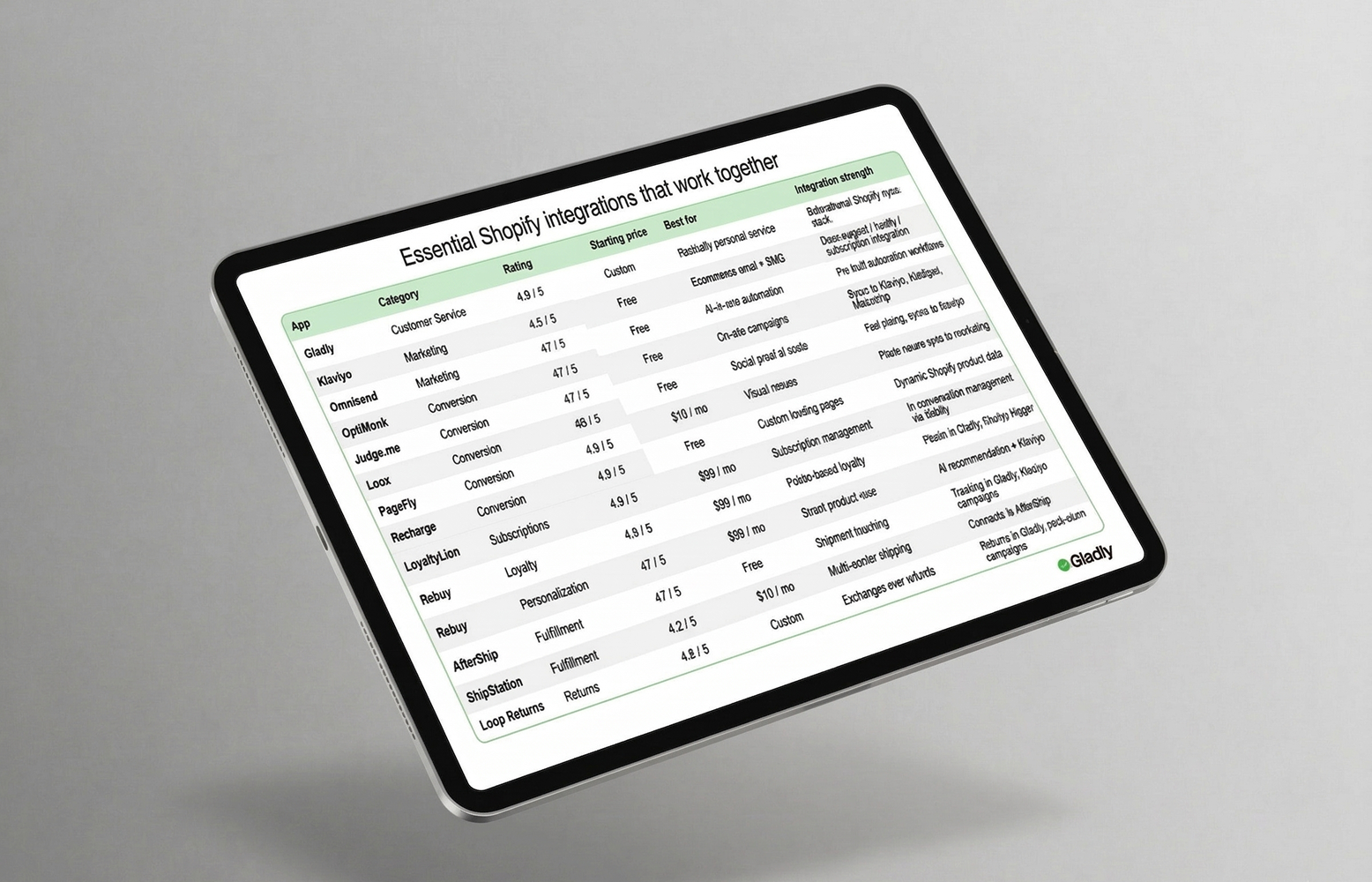
Quick comparison: 13 best Shopify integrations for your tech stack
Start with your three hubs (customer service, marketing, operations), then add apps that integrate with multiple hubs. Apps that connect to two or more of your core systems create compounding value
How to build your integration stack
Starting from scratch? Follow this framework:
Choose your hubs first: Pick one app for each hub: customer service, marketing automation, and operations. These become your integration anchors.
Add apps that connect to multiple hubs: Prioritize tools that integrate with at least two of your hubs. LoyaltyLion connecting to both Gladly and Klaviyo is more valuable than a standalone loyalty app.
Verify integration depth: Before buying, confirm how the integration actually works. "Integrates with Klaviyo" could mean full bidirectional sync or just a basic webhook. Check documentation or ask support for specifics.
Avoid creating new silos: If an app can't connect to your existing hubs, reconsider whether you need it. Every disconnected system fragments customer data and creates inefficiency.
Start small and expand strategically: You don't need 15 apps on day one. Build your three hubs, add 3-4 connected apps, and expand as you identify specific needs.
For stores at different growth stages, our guide to apps specifically for SMBs shows which tools make sense at each phase.
Ready to upgrade your Shopify support stack?
Join Shopify brands that use Gladly to turn customer conversations into repeat purchases and higher LTV.

Frequently asked questions
Recommended reading

Customer service automation
Automated CS is a purpose-built process which aids the customer experience by using AI driven modes of communication
By
Angie Tran

Migrating from WooCommerce to Shopify
As your ecommerce business grows and expands, you will likely need to update and reconsider your store platform of choice.
By
Angie Tran

3 long-term strategies to grow Shopify revenue in 2025
Don’t overlook the impact of marketplace cleanliness, organized sales channels, and powerful customer loyalty.
By
Angie Tran