

November 23, 202615 min read
How to choose an ecommerce platform: a decision framework for digital leaders


To choose an ecommerce platform, write down your requirements first, decide which architecture your team can run, score each vendor against weighted criteria, model total cost over three years, and test whether the platform's data reaches the people and AI who talk to your customers.
This guide is written for ecommerce, digital, and IT leaders at brands that already sell online and are choosing a platform to scale on. Most guides on this topic stop at features and fees. This one gives you a scorecard you can copy and a three-year cost model, and it covers the criterion most guides skip: whether your support team and AI can use the platform's data once you're live.
If you're launching your first store, there's a short section for you near the end.
How to choose an ecommerce platform in five steps
Start from your requirements and integration map before you build a vendor shortlist.
Pick the architecture your team can run: hosted SaaS, open source, headless, or composable.
Score every vendor against the same weighted criteria.
Compare total cost over three years, including apps, implementation, and developer time.
Make "data your support team and AI can use" a scored criterion.
Start with requirements before you build a shortlist
A shortlist built before requirements tends to follow whoever gave the best demo. Write the requirements down first, then let them decide which vendors get a call.
Start with what your business does today and what it needs to do over the next three years:
Catalog: how many SKUs you carry, how many variants each product has, and whether you sell bundles, kits, or made-to-order items.
Order volume: how many orders you take on your busiest day of the year.
Channels: direct-to-consumer, wholesale or B2B, marketplaces, and retail stores with POS.
International: the currencies, languages, and tax rules for every market you sell in or plan to enter.
Subscriptions and returns: how they work today and which tools run them.
Draw your integration map. List every system the new platform has to talk to: ERP, order management (OMS), product information management (PIM), warehouse or 3PL, payments, tax, email and SMS, reviews, loyalty, subscriptions, returns, and your support platform. For each one, note whether the connection today is a maintained app, a custom build, or a manual export someone runs every week.
Split the list into must-haves and nice-to-haves. A must-have is something you'd walk away over, so if a vendor can't handle it natively or with a maintained app, that vendor is out, however good the rest of the demo looks. Nice-to-haves become tiebreakers later.
Get the right people in the room early: ecommerce, IT or engineering, finance, operations, and CX. Support sees what breaks first, because customers report broken checkouts, missing tracking emails, and failed discount codes to support before anyone else hears about them. Before you lock the requirements, ask your support team what customers complain about. Their answers often turn into must-haves.
Decide which architecture your team can run
Ecommerce platforms come in four broad shapes, and each one asks something different of your team.
Hosted SaaS. The vendor handles hosting, security, and upgrades. You get less control over the code and work within the platform's limits and its app ecosystem. Shopify and BigCommerce are examples.
Open source. You get full control of the code, along with full responsibility for hosting, security patches, and upgrades. Magento Open Source is an example.
Headless. The storefront is split from the commerce engine, and the two talk through APIs. You can build whatever front end you want, but you need a front-end team to build it and keep it running.
Composable. You assemble separate services for search, cart, checkout, content, and more, and connect them through APIs. It's the most flexible option and the most to manage, since every service comes with its own vendor, contract, and upgrade schedule.
The deciding question is how many engineers you'll dedicate to the platform after launch. Composable asks for the most of them, and hosted SaaS asks for the fewest.
Traditional, or monolithic, ecommerce keeps the storefront and the commerce engine in one system, and headless splits them so you can change the front end without touching the back end. For a deeper comparison and the signs you're ready to make that move, read our guide to composable vs. headless vs. monolithic commerce.
Build a weighted scorecard
A weighted scorecard makes every vendor answer the same questions. List your criteria, give each one a weight so the weights add up to 100, score every vendor from 1 to 5 on each criterion, then multiply each score by its weight and add the results. Score from demos built on your own scenarios, with your catalog and your hardest checkout cases, because a vendor's own slides will always show the easy path.
The weights below are a starting example. Set your own from your requirements document: a brand with a complex B2B catalog might put 30 on fit to requirements, and a brand that has replatformed twice in five years might weight exit terms higher.
Sample ecommerce platform scorecard
Criterion | Example weight | What to look for | How to test it |
|---|---|---|---|
Fit to requirements | 20 | Must-haves met natively or with a maintained app | Scripted demo of your hardest catalog and checkout cases |
Integrations with your stack | 15 | A maintained connector for each system on your map, and a named maintainer | Ask who maintains each connector and how often it's updated |
Data your support team and AI can use | 15 | Order, customer, subscription, catalog, and inventory data via APIs; order actions via API | Ask for API docs; have your support platform vendor review them |
3-year total cost of ownership | 15 | All costs in the TCO table below | Fill in the TCO table for each finalist |
Scalability and peak performance | 10 | Evidence at your peak-day order volume | References at your volume; uptime and incident history |
Data portability and exit terms | 10 | Full exports of customers, orders, and subscriptions; contract exit terms | Request a sample export; read the termination clause |
Ecosystem and vendor support | 10 | Agencies, apps, and support SLAs at your tier | Talk to two agencies that implement it |
Time to launch | 5 | Realistic timeline for your scope | Ask references how long theirs took |
Here's how the arithmetic works, using made-up scores for one vendor: 4 on fit to requirements (4 × 20 = 80), 3 on integrations (45), 5 on data (75), 3 on total cost (45), 4 on scalability (40), 2 on portability (20), 4 on ecosystem (40), and 3 on time to launch (15). That vendor totals 360 out of a possible 500.
If two finalists land within a few points of each other, compare the must-have each one handles worst, and let that decide it.
Compare total cost of ownership over three years
The subscription fee is the number on the pricing page, so it gets the most attention. A platform with a low monthly fee can still cost more once you add the apps needed to match your current features, plus implementation and developer time. A three-year view also catches costs a first-year quote leaves out, like fees tied to revenue that climb as you grow and the apps you add after launch.
Use these categories to build a total cost of ownership model for each finalist.
Ecommerce platform total cost of ownership categories
Cost category | What it includes | One-time or recurring | Who has the number |
|---|---|---|---|
Platform subscription or license | Plan fee, often tied to revenue or order volume at higher tiers | Recurring | Vendor quote |
Payment and transaction fees | Processing rates and any fee for using a third-party gateway | Recurring | Vendor pricing page; your processor |
Hosting and infrastructure | Servers, CDN, and security (mostly open source and headless) | Recurring | IT or hosting provider |
Apps and extensions | Paid apps needed to match today's features | Recurring | Your feature gap list |
Implementation | Systems integrator or agency build, design, and QA | One-time | SI proposals |
Migration | Data migration, redirects, and integration rebuilds | One-time | SI proposals; replatforming plan |
Integrations and middleware | Connectors, iPaaS, and custom API work | Both | IT |
Ongoing development | Developer time for updates, fixes, and new features | Recurring | Engineering lead |
Internal team time | Staff hours on the project and on running the platform | Both | Department leads |
Support and CX changes | Reconnecting the support platform, retraining, and launch-week staffing | Both | CX lead |
Fees vary by plan and change often, so pull current numbers from each vendor's pricing page and from the quotes and proposals you collect. Once the table is filled in, add up all three years for each finalist and use the total to score the TCO row in your scorecard.
Score how well your support team and AI can use the platform's data
Cost covers what you'll pay. This criterion covers whether your support team and AI can do their jobs once the platform is live. Customers ask about orders, returns, subscriptions, and stock in chat, email, and voice. If that data doesn't flow out of the platform cleanly, team members switch between tabs to find answers and AI can't answer at all. If nobody checks this before you sign, the gap shows up after launch, when the questions are already coming in.
What to check in the platform's APIs
Ask each finalist for its API documentation, then have your support platform vendor review it against this list:
Order, customer, subscription, catalog, and inventory data are all available through APIs, ideally in real time or close to it.
The API supports actions as well as lookups: canceling an order, issuing a refund, editing a shipping address, and applying a discount code.
One customer ID holds across the storefront, subscriptions, loyalty, and support, so one person doesn't turn into three records.
Webhooks fire for order and fulfillment events, so other systems don't have to keep polling for changes.
Rate limits hold up at your peak-day order volume.
Check whether an AI shopping assistant can work with it
An on-site AI shopping assistant needs live catalog and inventory data to recommend products that are in stock, and it needs order access to answer "where's my order?" or make a change for the customer. If the platform only shares that data in a nightly export, the assistant will recommend items that sold out this morning and won't be much help after the sale.
External shopping agents are the next question. Outside shopping agents can now search and check out for a customer in some channels, and platforms are adding support for agentic commerce protocols like MCP, ACP, and UCP at different speeds. Ask each vendor what it supports for agent-driven shopping today and what's on its roadmap, with dates. If the terms are new to you, our glossary entry on agentic commerce covers the basics.
Score all of this inside the "data your support team and AI can use" row of your scorecard. It doesn't need a row of its own.
Gladly integrates with commerce platforms including Shopify, BigCommerce, Magento, Spree Commerce, and Swell, plus subscription, returns, and loyalty tools such as Recharge, Ordergroove, Skio, Loop, and Smile.io. You can see the full list on our integrations page. With the Shopify and BigCommerce integrations, Gladly can look up orders, cancel orders, and process refunds for customers. Every past chat, call, and email stays in one customer record, so the AI shopping assistant and your team members see the same history. Learn more about Gladly for ecommerce customer service.
Try Gladly AI right here
Choosing a platform? Ask Gladly AI.
Get a quick answer on integrations, order actions, and the store data an AI shopping assistant needs.
How to evaluate ecommerce platform vendors
Once you have requirements and a scorecard, a request for proposal (RFP) puts every vendor through the same process. An ecommerce platform RFP usually has five parts:
Company background and goals: who you are, what you sell, and what the new platform needs to change.
Requirements, with must-haves flagged.
Scored questions, each mapped to a row in your scorecard.
Scripted demos that use your data and your scenarios.
Commercial terms: pricing at your volume, contract length, renewal terms, and exit terms.
Questions to ask every vendor
Which of our must-haves are native, which need an app, and which need custom work?
Who maintains the connector for each system on our integration map?
What order, customer, subscription, and inventory data is available through your APIs, and which actions can we take through them?
What are your API rate limits, and what happens at our peak-day volume?
What's your uptime and incident history for the last 12 months?
What does pricing look like at our revenue and order volume in year three?
What support do we get at our tier, and what are the response times?
How do we export all customer, order, and subscription data if we leave?
Can we talk to three customers in our category at our volume?
What's on your roadmap for AI shopping assistants and agent-driven shopping?
Data portability and exit terms
Every platform contract ends eventually, and leaving is far easier if you plan for it before you sign. Ask for a sample export of customers, orders, and subscriptions, and check that it's complete enough to load somewhere else. Read the termination and data-return clauses with your legal team. Check whether customer passwords and subscription payment tokens can move to another platform, because if they can't, customers will have to reset passwords and re-enter their cards after a future move. When it's time to move, our ecommerce replatforming checklist covers the full migration plan.
Check references at your volume
Ask each vendor for references in your category at a similar order volume, and talk to them without the vendor on the call. Ask how the platform held up on their busiest days and what surprised them about costs in year two. It's also worth asking how long their integrations took compared with the original plan. If you're replacing your support platform too, run the same discipline on your support stack.
Launching your first store? Start simpler
Most of this framework is for brands moving off an existing platform, with years of data, integrations, and habits attached. If you're launching your first store, you can keep the decision much simpler.
Start with a hosted SaaS platform, so hosting, security, and upgrades are someone else's job. Shopify and BigCommerce are common choices, and Wix and Squarespace can work for very small catalogs. Before you pick, compare transaction fees, including any fee for using a third-party payment gateway, and count how many paid apps you'd need for the features you want, since those monthly charges add up. Keep custom work to a minimum while you learn what your customers need.
Plan to revisit the decision once your order volume and sales channels grow, which is when the scorecard and cost model above start to earn their time. For setup and customer service help along the way, browse Gladly's Shopify guides.
Make the call and plan the move
If you're replatforming, bring the scorecard and the three-year TCO to finance and leadership together. The scorecard shows which platform fits your business and the TCO shows what that fit costs, so presenting them side by side answers the question of why you didn't pick the cheapest option before anyone asks it. Once you've chosen, the work shifts to migration: timeline, data, SEO, integrations, and launch. When you're ready, use our checklist to plan the migration.
Frequently asked questions
Recommended reading
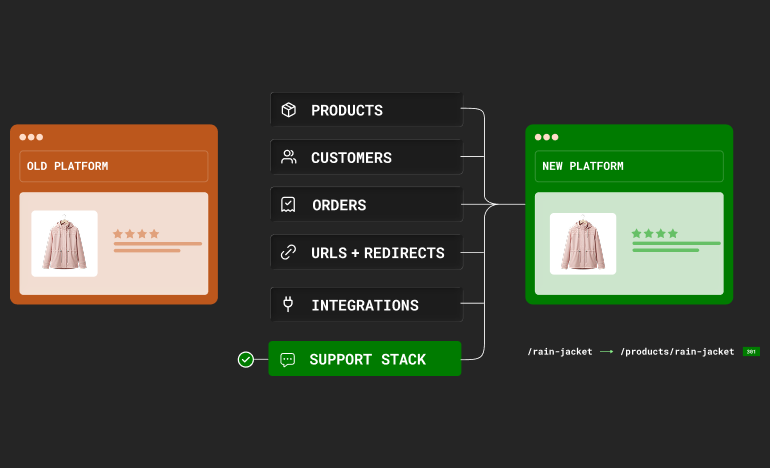
Ecommerce replatforming checklist: 9 phases from audit to post-launch
A phase-by-phase ecommerce replatforming checklist covering data, SEO, integrations, launch, and the customer service work most migration plans miss.
By
Gladly Editorial

Composable commerce explained: a practical primer for ecommerce leaders
What composable commerce is, how it compares to headless and monolithic platforms, what it asks of your team, and where Shopify and AI fit.
By
Gladly Editorial
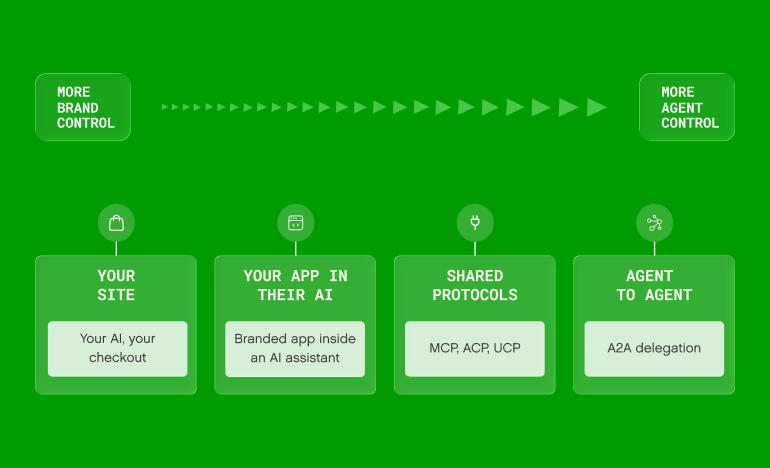
Making sense of agentic commerce protocols
MCP, ACP, UCP, and A2A explained — what each protocol does, how they relate, and where to sequence your agentic commerce investment.
By
Nidhi Nair